
Time: Oct 26 2026 Views: 10
A practical guide for cement plant maintenance engineers on diagnosing rotary kiln failures, selecting replacement components, and planning repairs with a custom parts manufacturer.
Rotary kiln repair is rarely as simple as replacing a damaged component.
When a cement kiln develops abnormal vibration, excessive drive noise, gearbox overheating, or irregular rotation, the visible symptoms may originate from several interconnected mechanical systems.
A damaged gearbox bearing, for example, may be associated with lubrication problems, shaft misalignment, excessive transmitted loads, or abnormal gear meshing. Similarly, premature girth gear wear may indicate problems with the kiln shell, support rollers, or drive alignment rather than defective gear teeth alone.
For maintenance engineers, the challenge is identifying the underlying cause before ordering replacement parts.
From a manufacturing perspective, successful rotary kiln repair requires two things:
This guide examines the critical components involved in rotary kiln repair, with particular attention to gearboxes, girth gears, pinion shafts, support rollers, and kiln tyres.
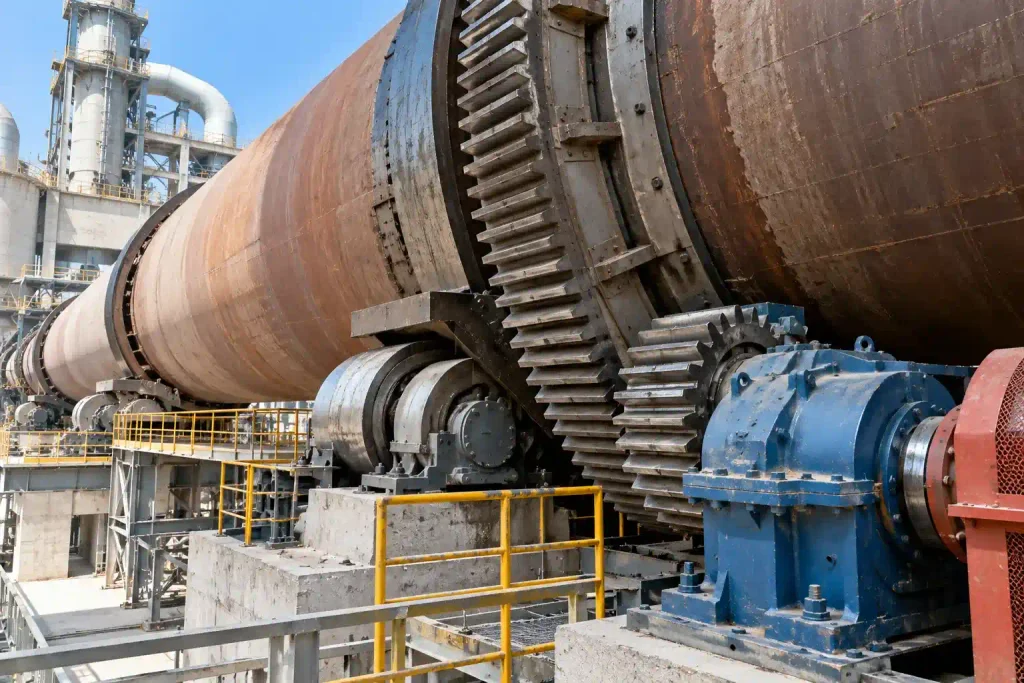
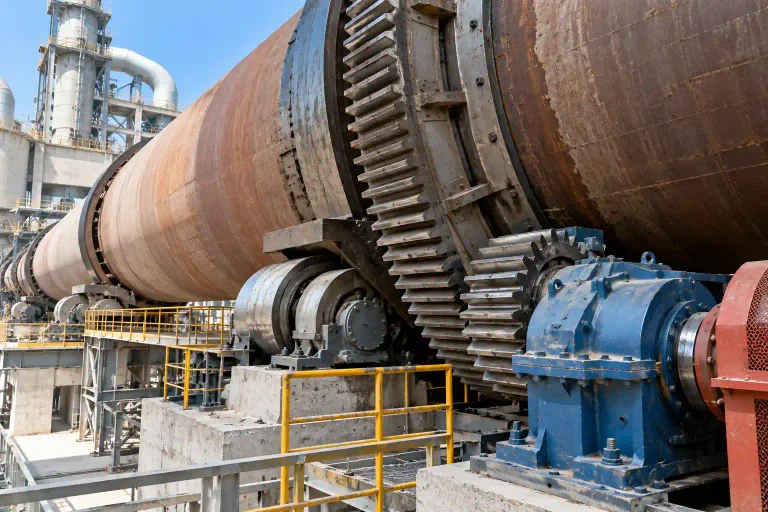
A rotary kiln relies on several mechanical systems working together.
The drive system rotates the kiln, while the support system carries the shell's weight and controls its position.
| Component | Primary Function | Common Repair Concerns |
| Gearbox / Speed Reducer | Reduces motor speed and transmits torque | Gear damage, bearing failure, overheating |
| Girth Gear | Transfers drive torque to the kiln shell | Tooth wear, pitting, cracking, runout |
| Drive Pinion | Engages the girth gear | Tooth damage, misalignment, shaft fatigue |
| Kiln Tyre / Riding Ring | Supports the rotating shell | Surface wear, cracks, deformation |
| Support Roller | Carries kiln loads and enables rotation | Uneven wear, bearing problems |
| Thrust Roller | Controls axial kiln movement | Excessive thrust, surface damage |
| Pinion Shaft | Transmits torque through the drive system | Fatigue, journal wear, distortion |
These components should not be evaluated independently.
For example, a support roller alignment problem can affect the kiln's rotational axis, which may change the contact pattern between the girth gear and drive pinion.
A replacement part should correct a confirmed component problem—not conceal an unresolved system problem.
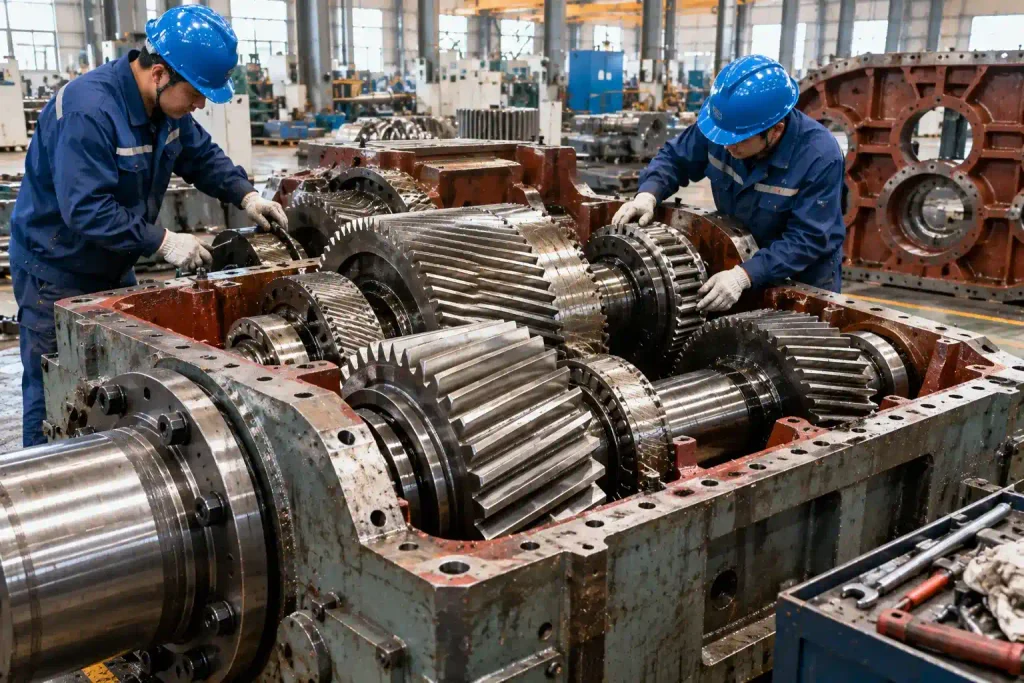
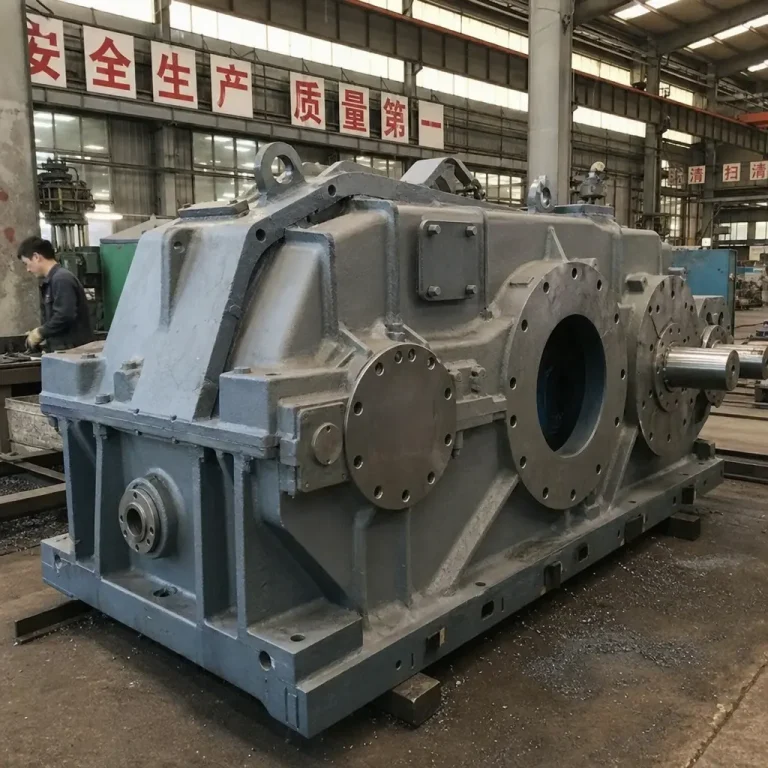
The gearbox is one of the most important components in a conventional rotary kiln drive system.
In a typical arrangement, an electric motor drives a speed reducer, which transmits torque through a coupling and pinion shaft to the girth gear.
The gearbox must operate under high torque, repeated loading, and demanding continuous-duty conditions.
Maintenance teams should investigate the following symptoms:
These symptoms do not necessarily indicate that the entire gearbox needs replacement.
They may originate from individual gears, shafts, bearings, couplings, lubrication systems, or external mechanical loads.
| Symptom | Possible Causes | Recommended Investigation |
| Excessive vibration | Gear damage, bearing wear, misalignment | Vibration analysis and alignment inspection |
| High temperature | Lubrication problems, overload, bearing damage | Oil analysis, temperature and load checks |
| Metallic debris in oil | Gear or bearing deterioration | Oil debris analysis and internal inspection |
| Repeated bearing failure | Shaft deflection, incorrect fits, misalignment | Shaft and housing measurements |
| Abnormal gear noise | Tooth damage, backlash or contact problems | Gear inspection and contact assessment |
| Oil leakage | Seal deterioration, housing or vent problems | Inspect seals, shaft surfaces and housing |
The maintenance team should establish whether the problem is internal to the gearbox or caused by another part of the kiln drive.
For instance, excessive loading caused by poor girth gear and pinion contact may increase stress on gearbox components.
Replacing a damaged gearbox gear without correcting the external load condition can result in another failure.
A complete gearbox replacement may not always be necessary.
Depending on the damage and the condition of the remaining components, repairs may involve:
However, major cracks, extensive internal damage, distorted housings, or obsolete designs may justify a more comprehensive replacement.
A qualified gearbox specialist should assess the complete assembly before deciding whether individual components can be reused.
From a manufacturer's perspective, gearbox repair often presents an opportunity to evaluate the quality and suitability of the original transmission components.
Large industrial gearboxes may contain spur gears, helical gears, bevel gears, or other transmission elements depending on the drive configuration.
The manufacturing requirements depend on gear geometry, transmitted torque, operating speed, and design specifications.
Gear materials must provide an appropriate combination of:
For some gearbox applications, alloy steels suitable for quenching and tempering or case hardening may be specified.
However, the correct material cannot be selected from hardness alone.
The gear's dimensions, load spectrum, heat treatment requirements, and compatibility with its mating gear must also be considered.
Depending on the design, gearbox gears and shafts may require normalizing, quenching and tempering, carburizing, induction hardening, or other specified processes.
The purpose is to achieve the required mechanical properties and fatigue performance.
Heat treatment selection must be compatible with the steel grade, gear geometry, and manufacturing route.
For replacement gearbox gears, manufacturing accuracy is particularly important.
Critical requirements may include:
A replacement gear that fits inside the gearbox but does not meet the required meshing accuracy may create vibration, noise, and premature wear.
LANGTENG can evaluate custom gear and shaft manufacturing projects based on existing drawings, material specifications, dimensional requirements, and inspection criteria.
For older equipment, reverse engineering may be considered when complete original drawings are unavailable.
However, reverse engineering must establish more than external dimensions. Gear geometry, material requirements, operating loads, and mating-component compatibility must also be verified.
The girth gear is one of the largest and most expensive mechanical components in a conventional rotary kiln drive.
Its function is to transmit torque from the drive pinion to the kiln shell.
Over time, girth gears may experience:
Not all visible wear requires immediate replacement.
The decision depends on the severity of the damage, remaining tooth geometry, crack condition, alignment, and operating requirements.
A damaged girth gear may be the result of:
Poor pinion alignment
Uneven contact across the tooth face can produce concentrated stresses.
Inadequate lubrication
Poor lubricant application or contamination can accelerate surface damage.
Kiln shell deformation
Changes in shell geometry can affect the position of the girth gear relative to the pinion.
Mounting problems
Loose fasteners, damaged mounting interfaces, or structural movement can affect gear runout.
Incorrect replacement geometry
An improperly manufactured or installed replacement gear may not mesh correctly with the existing pinion.
Before ordering a new girth gear, maintenance engineers should review the gear's condition together with the kiln's mechanical alignment.
Depending on the condition and design, the available options may include:
These decisions require engineering assessment. Tooth welding, grinding, and gear reversal should not be treated as universal repair methods.
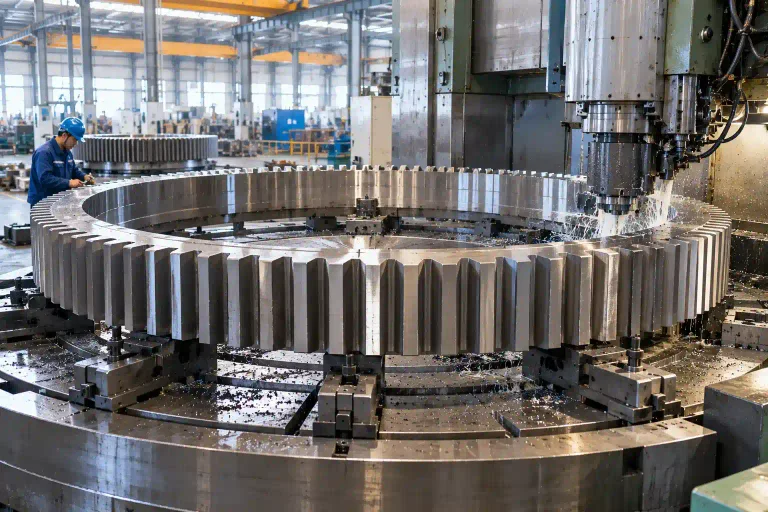
For large cement kilns, replacement girth gears are often manufactured as segmented steel castings.
Custom manufacturing requirements may include:
A custom replacement gear must match the approved drive design and installation requirements.
Related reading: How Long Does a Cement Kiln Girth Gear Last? A Manufacturer's Guide.
The drive pinion and its shaft operate under repeated torque and tooth loading.
Pinion-related problems can affect the entire drive system.
Common damage includes:
When replacing a pinion shaft, maintenance engineers should verify both gear and shaft specifications.
Important information includes the tooth geometry, shaft dimensions, bearing arrangements, material properties, and required heat treatment.
For some projects, manufacturing a complete pinion shaft assembly may be more appropriate than attempting to restore a severely damaged component.
The mating girth gear must also be inspected. Installing a new pinion against a badly worn girth gear can create unfavorable contact conditions.
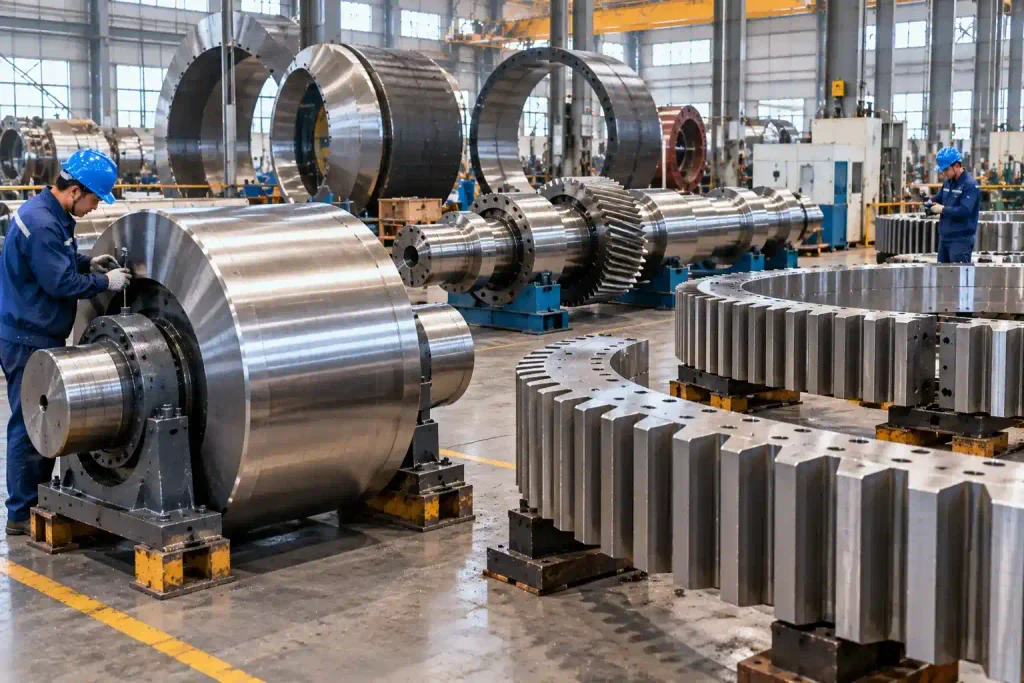
The kiln tyre, also called a riding ring, supports the rotating kiln shell through contact with the support rollers.
These components carry substantial mechanical loads.
Some worn roller and tyre surfaces can be restored through specialist in-situ machining or grinding.
However, significant cracks, excessive material loss, or structural damage may require component replacement.
Before deciding, the maintenance team should evaluate the remaining dimensions, material condition, alignment, and relevant design limits.
Custom support rollers and kiln tyres require careful control of:
For replacement projects, dimensional compatibility with the existing kiln structure is essential.
Before ordering major replacement components, maintenance engineers should organize the repair process around verified technical information.
Record abnormal noise, vibration, temperatures, oil condition, visible damage, and operating changes.
Compare current measurements with historical data where available.
Determine whether the problem originates from the gearbox, gear mesh, support system, kiln shell, or another component.
Use appropriate inspection methods, including vibration analysis, oil analysis, dimensional measurement, and non-destructive testing.
Assess whether the damaged component can be safely repaired and whether sufficient material and structural integrity remain.
Consider the remaining service life, repair risks, replacement cost, and planned shutdown duration.
Confirm dimensions, material grades, mechanical properties, mating interfaces, and inspection requirements.
For obsolete equipment, establish whether reverse engineering is required.
Large girth gears, kiln tyres, rollers, and shafts may require substantial manufacturing lead times.
Maintenance teams should coordinate engineering approval, production, inspection, transportation, and installation schedules.
After replacement, qualified personnel should verify alignment, gear contact, backlash, lubrication, bearing temperatures, vibration, and other specified commissioning parameters.
Major mechanical repairs must follow site safety procedures, including energy isolation, mechanical restraint, lifting plans, and approved return-to-service checks.
The quality of a custom replacement component depends heavily on the information available at the beginning of the project.
For a rotary kiln repair inquiry, provide as much of the following as possible:
| Information | Why It Matters |
| Equipment manufacturer and model | Identifies the original configuration |
| Component name and part number | Establishes replacement scope |
| Technical drawings | Defines geometry and interfaces |
| Material specification | Establishes mechanical requirements |
| Dimensions and tolerances | Supports manufacturing accuracy |
| Damage photographs | Helps identify failure characteristics |
| Operating conditions | Supports material and design evaluation |
| Inspection requirements | Defines quality documentation |
| Required delivery date | Supports shutdown planning |
When original drawings are unavailable, photographs and dimensional measurements can support an initial feasibility discussion.
However, critical replacement parts may require additional measurements, engineering calculations, or formal design approval before manufacturing.
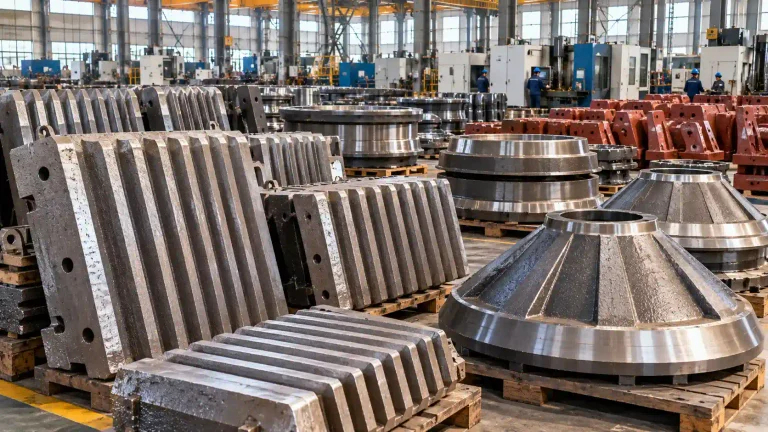
LANGTENG focuses on heavy industrial components manufactured for demanding operating environments.
For rotary kiln repair and replacement projects, our relevant product scope includes:
Girth Gears
Large cast-steel ring gears, including custom segmented configurations.
Industrial Gears and Pinion Shafts
Custom transmission components manufactured according to approved technical requirements.
Kiln Tyres
Heavy-duty riding rings for rotary kiln support systems.
Support Rollers
Custom roller components and related shaft assemblies.
Thrust Rollers
Replacement components for kiln axial positioning systems.
Custom Castings and Forgings
Heavy industrial components manufactured according to drawings and project specifications.
A custom replacement project begins with understanding the original component and its operating requirements.
The engineering review may address:
For customers seeking to improve component reliability, material upgrades or design modifications should be evaluated against actual failure data and approved engineering requirements.
LANGTENG's role is to support the manufacturing of suitable replacement components. On-site kiln alignment, gearbox overhaul, installation, and commissioning should be performed by qualified specialists unless separately agreed within the project scope.
Common problems include gearbox overheating, bearing deterioration, gear tooth wear, pinion misalignment, abnormal vibration, and lubrication-related damage.
The root cause should be established before replacing components.
In many cases, individual gears, shafts, bearings, seals, or other components can be replaced.
However, the feasibility depends on the extent of damage and the condition of the gearbox housing and remaining components.
Some forms of wear or damage may be repairable through specialist methods.
Severe cracking, excessive tooth damage, or unacceptable geometry may require replacement. A qualified inspection is necessary to determine the appropriate solution.
Potentially. Reverse engineering can help establish dimensions and manufacturing requirements, but critical components also require verification of material properties, loads, gear geometry, and compatibility.
Not always. The decision depends on the condition of both components, tooth geometry, contact patterns, and engineering compatibility.
A new component should not be installed against a severely damaged mating component without a suitable assessment.
Repeated failures may result from unresolved lubrication problems, shaft misalignment, bearing issues, abnormal external loading, gear contact problems, or unsuitable replacement components.
Failure analysis should examine the entire drive system.
Technical drawings, material specifications, equipment information, dimensional measurements, damage photographs, and the planned shutdown schedule are useful starting points.
Rotary kiln repair is a combination of mechanical diagnosis, engineering evaluation, and reliable component manufacturing.
A gearbox failure may involve problems elsewhere in the drive system. Girth gear damage may reflect kiln alignment or lubrication conditions. Premature roller wear may indicate abnormal loading rather than a material defect alone.
For maintenance engineers, the most effective approach is to understand why a component failed before selecting its replacement.
For replacement parts manufacturers, the responsibility is to produce components that meet the required material, dimensional, and mechanical specifications.
Need Custom Components for a Rotary Kiln Repair Project?
LANGTENG supports custom manufacturing inquiries for girth gears, pinion shafts, kiln tyres, support rollers, and other heavy industrial components.
Send us your technical drawings, component specifications, or replacement requirements to discuss manufacturing feasibility and quotation options.
Request a Custom Rotary Kiln Parts Quote
@ 2025-2026 Langteng Machinery