
Time: Oct 26 2026 Views: 9
A cement kiln girth gear can operate for 15–20 years or longer under favorable conditions, but its actual service life depends on much more than routine maintenance. Gear design, material selection, casting quality, heat treatment, machining accuracy, and operating conditions all influence long-term reliability.
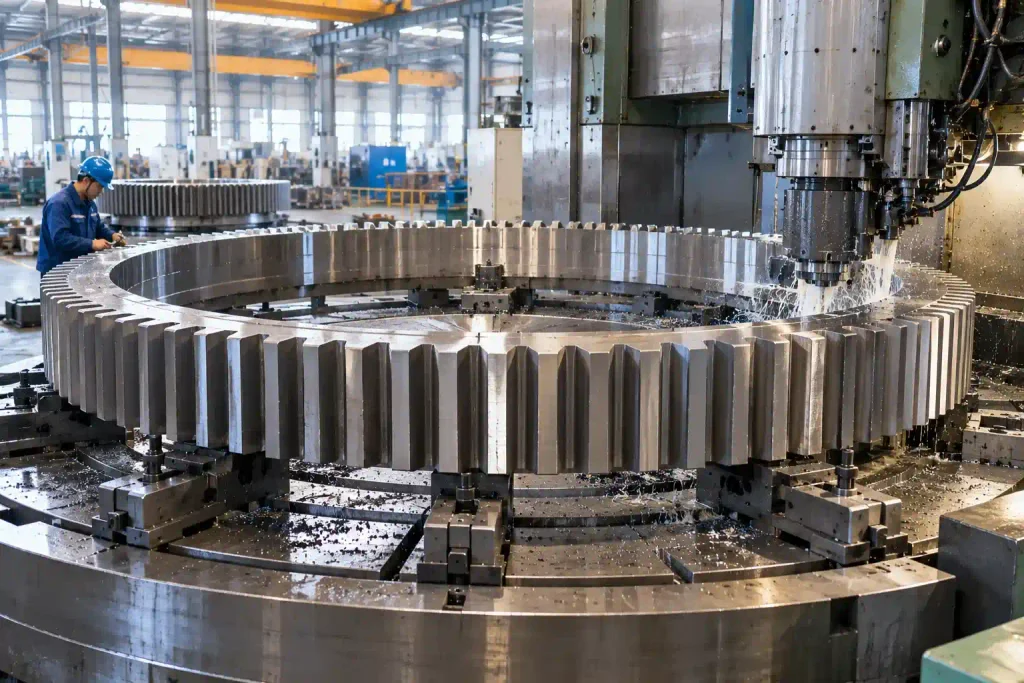
For cement plant operators, the important question is not simply how many years a girth gear should last. It is why some gears continue operating reliably for decades while others develop excessive wear, pitting, or tooth damage much earlier.
From the perspective of a heavy industrial component manufacturer, the answer begins before the gear is installed.
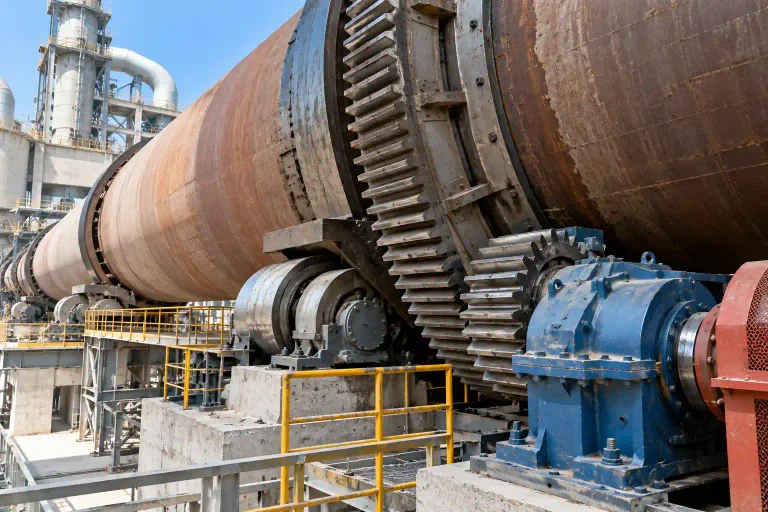
A large girth gear, also called a ring gear or bull gear, transmits torque from the drive pinion to the rotary kiln shell.
Because cement kilns often operate continuously, these gears must withstand repeated tooth loading, thermal movement, vibration, and demanding environmental conditions.
A service life of approximately 15–20 years is a useful planning reference for a well-designed and properly maintained kiln girth gear. Some installations operate considerably longer, while others require replacement much sooner.
However, this range is not a universal manufacturing specification or guaranteed lifespan.
A girth gear's actual service life depends on:
The distinction is important: two girth gears of similar dimensions may have very different reliability characteristics if their materials, manufacturing processes, and operating environments differ.
Material selection is one of the earliest decisions affecting girth gear performance.
Large cement kiln girth gears are commonly manufactured from cast steel because casting enables the production of large, complex ring structures that would be difficult or uneconomical to manufacture using other methods.
However, not all cast steels provide the same combination of mechanical properties.
A suitable girth gear material must balance several requirements:
Strength: The gear teeth must withstand transmitted torque and repeated bending stresses.
Toughness: The material must resist cracking under shock loading and fluctuating operating conditions.
Wear resistance: Tooth surfaces must tolerate repeated rolling and sliding contact.
Hardenability: The material must respond appropriately to the selected heat treatment process.
Manufacturability: The steel must be suitable for producing a large, dimensionally stable casting.
Higher hardness is not automatically better. Excessive hardness without adequate toughness can increase susceptibility to cracking, while insufficient surface strength may contribute to accelerated wear or contact fatigue.
At LANGTENG, material selection for a custom girth gear project begins with understanding the application rather than choosing a steel grade solely from a catalog.
Relevant information includes kiln dimensions, transmitted power, operating speed, gear geometry, existing material specifications, and observed failure modes.
Depending on the design requirements, candidate materials may include engineering cast-steel grades such as ZG310-570 or ASTM A148 grades, subject to verification against the required mechanical properties and applicable standards.
For replacement projects, material substitution should be evaluated carefully. A stronger or harder steel is not necessarily a better choice unless the gear design, pinion material, heat treatment, and loading conditions are compatible.
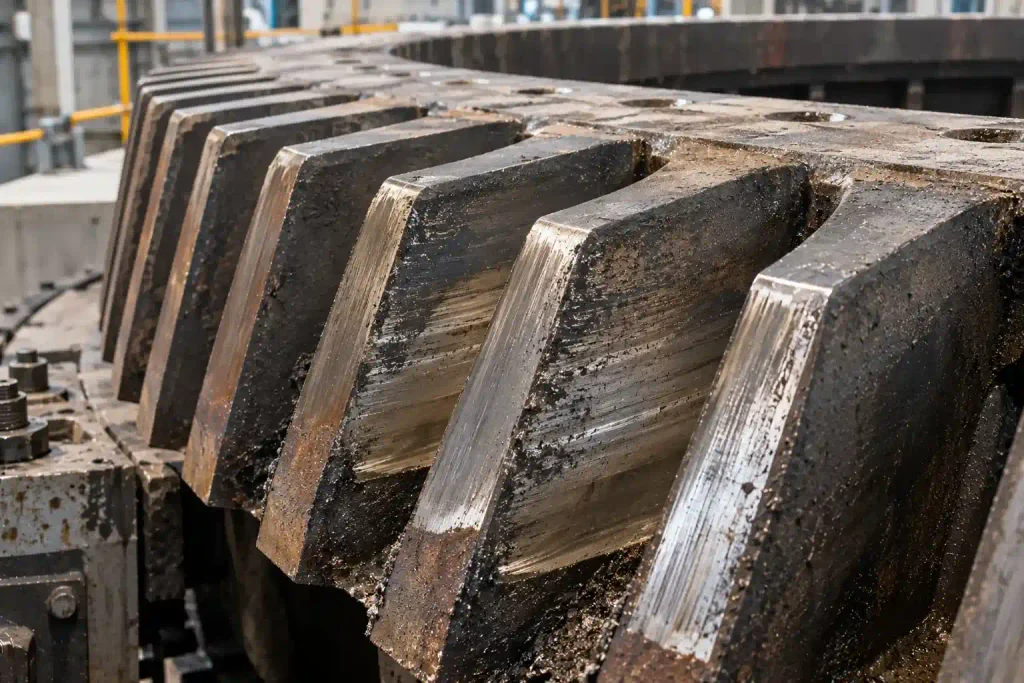
A cement kiln girth gear may weigh many tonnes and have a diameter of several metres.
Producing such a component requires careful control of molten steel quality, mould design, feeding, solidification, and subsequent processing.
Potential casting defects include:
These defects can become stress concentration points, particularly when located near highly loaded regions.
A gear may appear dimensionally correct after machining but still contain internal discontinuities that affect its fatigue performance.
For large custom steel castings, inspection requirements should be established before production.
Depending on the applicable specification, the inspection plan may include:
Inspection methods, coverage, acceptance criteria, and reporting requirements should be agreed upon during engineering review.
The objective is not merely to manufacture a gear that fits the kiln, but to deliver a component with the material integrity and dimensional characteristics required for its intended duty.
Heat treatment is another major factor influencing girth gear performance.
Large cast-steel components may contain residual stresses generated during solidification and cooling. Without suitable process control, these stresses can contribute to distortion during machining or service.
Depending on the steel grade and required properties, the manufacturing route may involve normalizing, tempering, stress relieving, or other qualified heat treatment processes.
The objectives include:
For large gears, the heat treatment process must consider section thickness, heating uniformity, cooling conditions, and the response of the selected alloy.
A process suitable for a small gear may not be appropriate for a multi-tonne girth gear.
This is why manufacturing engineering should consider the entire component rather than only the final tooth hardness.
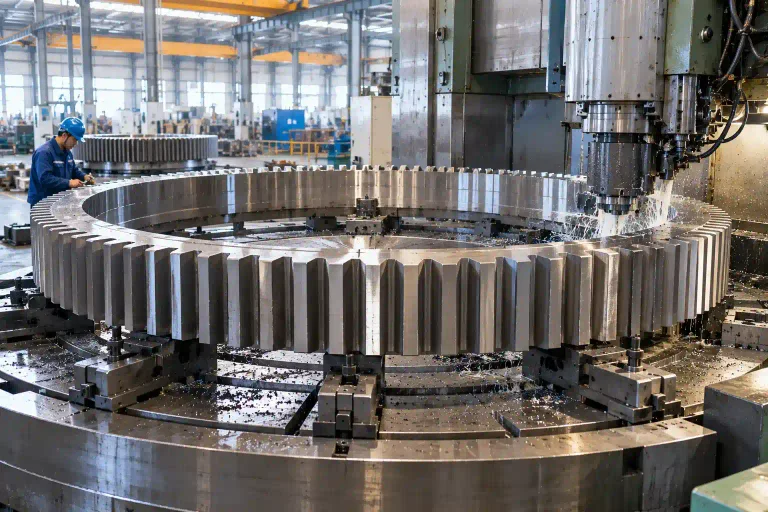
Even a sound casting made from suitable steel can experience premature damage if the gear teeth are not manufactured accurately.
The girth gear and drive pinion must mesh correctly under operating conditions.
Important manufacturing characteristics include:
Inadequate accuracy can contribute to uneven load distribution across the tooth face.
When contact becomes concentrated near one edge, local tooth stresses increase. Over time, this may promote pitting, abnormal wear, or fatigue cracking.
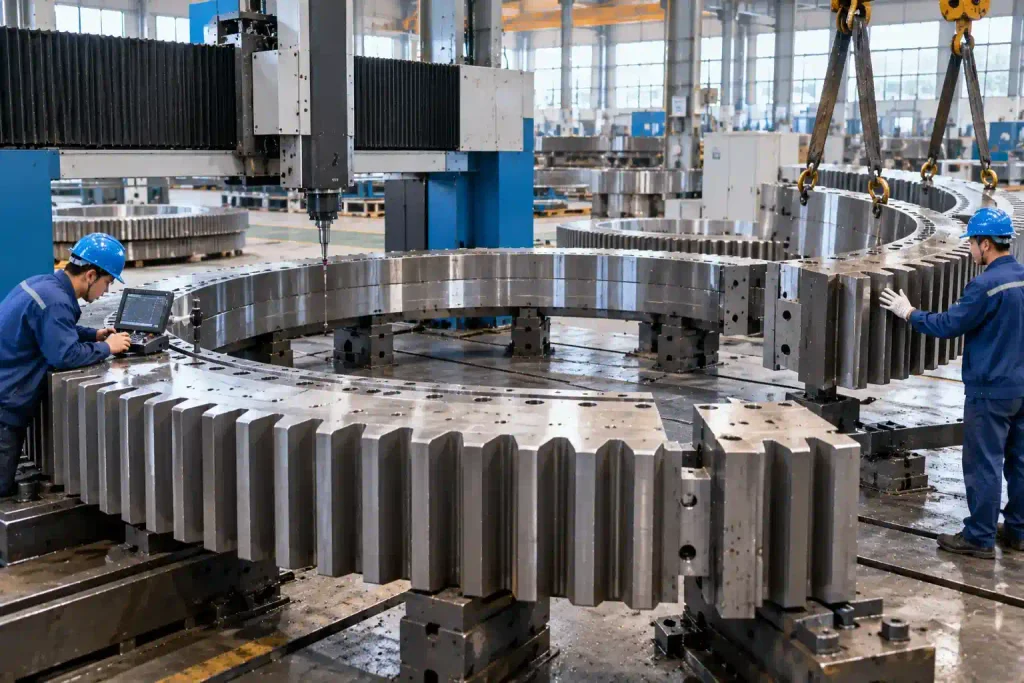
Large kiln girth gears are frequently manufactured in two or more segments to simplify production, transportation, and installation.
However, segmented construction introduces additional engineering requirements.
The joint surfaces, connection geometry, alignment features, and assembly procedures must be controlled to maintain the intended gear geometry after installation.
For custom split girth gears, LANGTENG can evaluate requirements involving:
The final manufacturing plan should be based on the approved design and project-specific tolerances.
Manufacturing quality establishes the foundation for service life, but it cannot eliminate damage caused by unsuitable operating conditions.
Several common problems can shorten the life of a cement kiln girth gear.
A rotary kiln experiences thermal expansion and structural movement during operation.
These changes can affect the relative position of the girth gear and pinion.
Poor alignment creates uneven tooth contact and localized loading, increasing the risk of wear and fatigue damage.
Cement kiln girth gears generally operate as open gear systems.
Dust contamination, inadequate lubricant application, unsuitable lubricant selection, or blocked spray nozzles can damage tooth surfaces.
The lubrication system must provide sufficient protection under the actual loading and environmental conditions.
Thermal distortion, shell runout, foundation movement, and supporting roller conditions can influence gear alignment.
A correctly manufactured gear cannot compensate indefinitely for significant changes in the kiln's operating geometry.
Repeated shock loading, drive irregularities, and abnormal torque conditions may accelerate fatigue damage.
For this reason, premature gear failure should be investigated as a system-level problem rather than attributed automatically to the gear material.
Custom manufacturing offers opportunities to improve reliability, especially when the original component has experienced recurring problems.
However, customization should begin with a technical evaluation rather than simply increasing material hardness or tooth dimensions.
At LANGTENG, a replacement girth gear project can be approached through several engineering considerations.
Review the existing steel grade, operating conditions, and failure characteristics to determine whether an alternative material specification is appropriate.
Manufacture replacement components according to approved drawings and verified dimensional requirements.
For older equipment, dimensional measurement and reverse engineering may help establish the information required for a replacement design.
Select a process compatible with the steel grade, component dimensions, and specified mechanical properties.
Establish the required casting, machining, heat treatment, and inspection documentation before production.
Evaluate segmented manufacturing and transportation requirements for large-diameter girth gears.
The objective of customization is to address the actual engineering requirements of the application—not to promise a longer lifespan without supporting design calculations and operating data.
Age alone should not determine replacement.
A gear that has operated for 20 years may remain serviceable, while a much newer gear may require corrective action.
Important warning signs include:
The decision to repair, reverse, recondition, or replace a girth gear should follow a qualified mechanical assessment.
This may involve tooth inspection, non-destructive testing, alignment measurements, vibration analysis, and review of the gear's operating history.
For replacement planning, cement plants should also consider the time required for engineering review, casting, heat treatment, machining, inspection, transportation, and installation.
Ordering a custom girth gear before a critical failure can reduce the risk of an extended unplanned shutdown.
LANGTENG focuses on heavy industrial components for demanding applications, including rotary kiln girth gears, industrial transmission gears, pinion shafts, and custom cast or forged components.
For cement plant replacement projects and industrial equipment applications, our manufacturing approach emphasizes engineering requirements, material selection, and dimensional compatibility.
Material Specifications
Custom cast-steel grades and mechanical property requirements based on approved technical specifications.
Gear Dimensions
Custom outside diameter, module, tooth count, face width, and mounting dimensions.
Split Girth Gear Construction
Segmented designs for large-diameter equipment, subject to engineering review.
Machining Requirements
Gear tooth machining, mounting interfaces, joint surfaces, and dimensional tolerances.
Inspection Documentation
Project-specific inspection and material documentation according to agreed requirements.
Replacement and Reverse Engineering
Manufacturing support based on existing drawings, samples, or verified measurements.
To evaluate a project, customers should provide:
These details help establish manufacturing feasibility, technical requirements, and quotation scope.
A well-designed and properly maintained cement kiln girth gear may operate for approximately 15–20 years or longer. Actual service life varies significantly with design, manufacturing quality, loading, alignment, lubrication, and maintenance.
Not necessarily. Forging and casting produce different material characteristics and manufacturing possibilities. Service life depends on the complete gear design, steel properties, manufacturing quality, and operating conditions. A properly engineered cast-steel girth gear can provide long service in demanding kiln applications.
Common contributors include inadequate lubrication, gear misalignment, uneven tooth contact, contamination, excessive loading, and dimensional or material deficiencies.
Often, yes. A replacement girth gear can be engineered to match an existing kiln's mounting arrangement and drive requirements. However, the condition of the pinion, mounting system, kiln shell, and supporting structures should also be evaluated.
Custom manufacturing can be evaluated using existing drawings, material specifications, and technical requirements. For older equipment, reverse engineering and dimensional verification may be necessary before a manufacturing design can be finalized.
A cement kiln girth gear is not simply a large steel ring with machined teeth. It is a critical transmission component whose performance depends on the interaction of materials, manufacturing, installation, and operation.
Maintenance plays an essential role in extending service life, but manufacturing decisions made years earlier also matter.
Material selection, casting integrity, heat treatment, gear accuracy, and appropriate customization all contribute to long-term reliability.
For cement plants planning a replacement or upgrading an existing drive system, evaluating these factors together is more valuable than relying on a single expected service-life figure.
Looking for a Custom Cement Kiln Girth Gear Manufacturer?
LANGTENG supports custom heavy industrial component projects involving cast-steel girth gears, large transmission components, and replacement parts manufactured to technical requirements.
Send us your drawings, material specifications, or existing gear information to discuss your project.
Request a Custom Girth Gear Quote
@ 2025-2026 Langteng Machinery