
Time: Oct 27 2026 Views: 11
A Manufacturer's Guide to Wear Life, Replacement Timing, Material Selection and Custom Crusher Parts
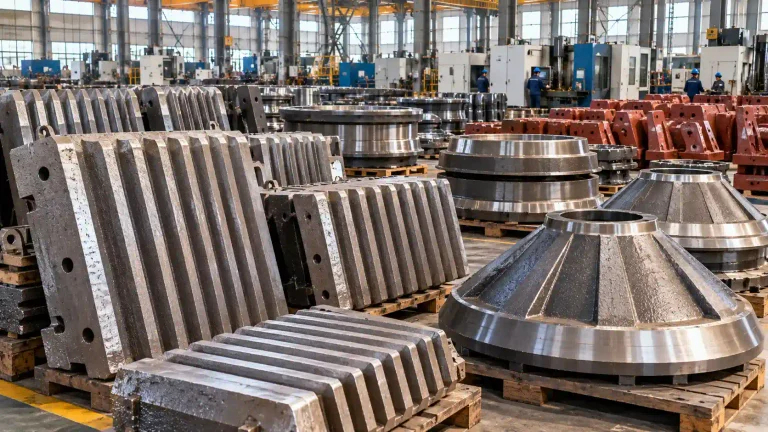
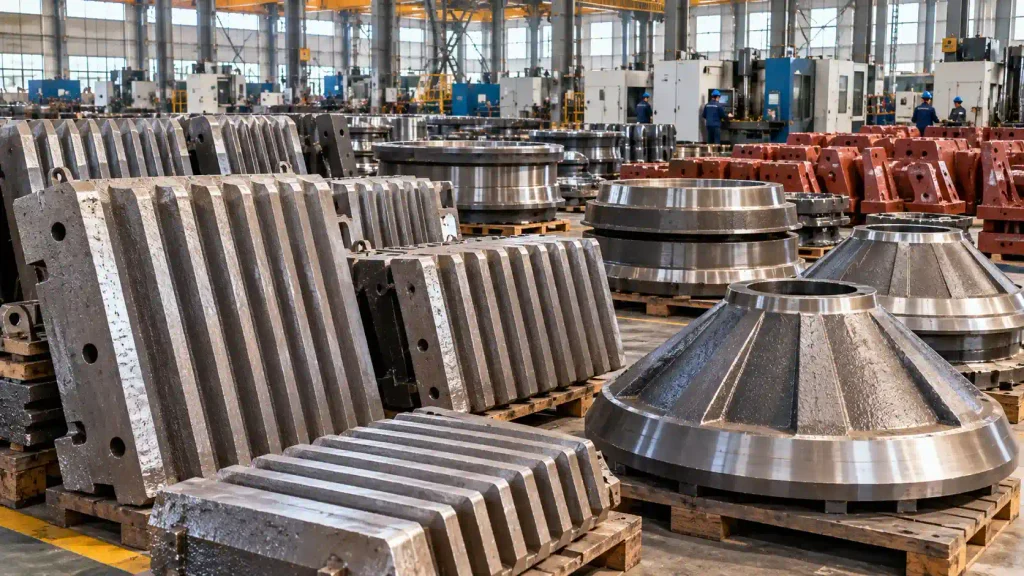
Crusher wear parts are among the most frequently replaced components in mining and aggregate crushing operations. Jaw plates, mantles, concaves, blow bars, and other wear components are continuously exposed to abrasion, impact, and high compressive loads.
For maintenance engineers and purchasing managers, two questions are especially important:
When should crusher wear parts be replaced?
How can we reduce crusher wear parts costs without compromising production?
The answers are closely connected.
Replacing wear parts too early wastes usable material and increases purchasing costs. Replacing them too late can reduce crushing efficiency, increase energy consumption, damage equipment, and create unplanned downtime.
From a manufacturer's perspective, controlling wear costs requires more than producing harder or cheaper replacement parts. It involves selecting suitable materials, controlling casting quality, understanding wear patterns, and manufacturing components that match the actual crushing application.
This guide explains how to make better replacement decisions and improve the cost efficiency of crusher wear parts.
There is no universal replacement interval for crusher wear parts.
Two identical crushers operating at different sites may experience very different wear rates because of variations in rock hardness, abrasiveness, feed size, moisture, crushing settings, and operating practices.
A jaw plate may last for a long production campaign in one quarry but require replacement much sooner when processing highly abrasive ore.
For this reason, replacement decisions should be based on measured wear, crushing performance, and equipment-specific limits, rather than operating hours alone.
1. Excessive material loss
Wear parts gradually lose thickness during operation.
When the remaining material approaches the minimum permitted by the equipment manufacturer, replacement becomes necessary to protect the underlying crusher components.
2. Changes in tooth or liner profile
A worn jaw plate or cone crusher liner may no longer maintain the intended crushing geometry.
This can affect material gripping, crushing efficiency, and product size distribution.
3. Reduced crushing capacity
If throughput decreases under comparable operating conditions, worn crushing surfaces may be one contributing factor.
However, feed conditions, settings, and other mechanical issues should also be investigated.
4. Abnormal vibration or operating loads
Changes in vibration, motor current, or power consumption can indicate abnormal operating conditions.
These signals are not proof of liner wear by themselves, but they warrant investigation.
5. Cracks, loose components, or structural damage
Cracked, broken, displaced, or improperly retained wear parts require prompt assessment.
Operating with damaged liners can create risks for personnel and equipment.
Different crusher designs have different wear mechanisms.
Maintenance teams should therefore use component-specific inspection criteria.
| Crusher Type | Main Wear Parts | Important Replacement Indicators |
| Jaw Crusher | Fixed and movable jaw plates | Tooth flattening, abnormal wear profile, minimum remaining thickness |
| Cone Crusher | Mantle and concave / bowl liner | Chamber profile changes, thickness limits, capacity or gradation deterioration |
| Gyratory Crusher | Mantle and concave segments | Excessive liner wear, reduced protection of supporting surfaces, abnormal chamber geometry |
| Impact Crusher | Blow bars and impact plates | Reduced working profile, cracks, damaged retention areas, minimum permitted dimensions |
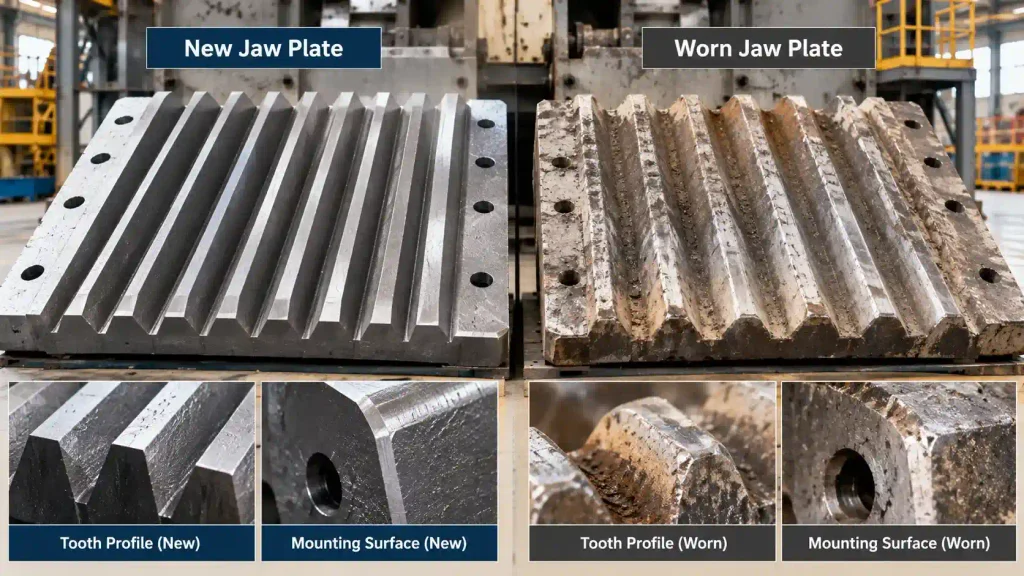
Jaw plates are commonly manufactured from austenitic manganese steel because of its toughness and ability to work-harden under suitable impact and compressive loading.
As the teeth wear, the crushing chamber gradually loses its original gripping characteristics.
Maintenance engineers should monitor:
Some jaw plate designs permit rotation or repositioning to improve material utilization.
However, not every jaw plate is designed to be rotated. Always follow the equipment manufacturer's approved procedures and dimensional limits.
Cone crusher liners determine the geometry of the crushing chamber.
As the mantle and concave wear, the effective chamber shape changes.
Even if the closed-side setting remains unchanged, worn liner profiles can affect feed acceptance, material flow, throughput, and product gradation.
Replacement should be considered when:
Replacing liners based only on weight loss may overlook important changes in crushing geometry.
Blow bars experience repeated high-energy impact.
Their performance depends on the processed material, rotor design, operating speed, and selected wear material.
Replacement indicators may include:
Some blow bar designs allow repositioning or reversal. Such operations must be explicitly supported by the component design and approved maintenance procedures.
One of the most common purchasing mistakes is evaluating crusher wear parts only by their purchase price or operating hours.
A component that lasts longer may still be more expensive if it reduces crushing capacity or increases maintenance costs.
The more useful performance indicator is:
Crusher Wear Parts Cost per Ton of Material Processed
For a simple wear-component comparison:
Cost per ton = (Wear parts purchase cost + Replacement labor + Allocated downtime cost) / Tons processed during the wear campaign
This calculation can be expanded to include lifting equipment, consumables, disposal, and other relevant expenses.
Consider two hypothetical jaw plate sets operating under comparable conditions.
| Cost Factor | Standard Jaw Plates | Optimized Jaw Plates |
| Purchase price | $8,000 | $10,000 |
| Material processed | 100,000 tons | 150,000 tons |
| Replacement labor | $1,000 | $1,000 |
| Allocated downtime cost | $3,000 | $3,000 |
| Total campaign cost | $12,000 | $14,000 |
| Wear cost per ton | $0.120 | $0.093 |
In this illustrative example, the optimized jaw plates cost 25% more to purchase but reduce the calculated wear cost per ton by approximately 22%.
The figures are hypothetical, not a LANGTENG customer case or a guaranteed performance improvement.
The result demonstrates why purchase price alone is not a sufficient measure of crusher wear-part value.
The same principle applies to cone crusher liners, gyratory crusher components, and impact crusher blow bars.
From a manufacturing perspective, material selection is one of the most important factors affecting crusher wear performance.
Different crushing applications require different combinations of hardness, toughness, work-hardening behavior, and resistance to abrasion.
Austenitic manganese steels are widely used for jaw plates, mantles, and concaves.
Common specifications include manganese steel grades with different manganese and carbon contents.
These materials are valued for their toughness and work-hardening characteristics.
However, a higher manganese content does not automatically guarantee longer wear life.
Performance depends on the material composition, heat treatment, loading conditions, and crushing application.
High-chromium cast irons can provide strong abrasion resistance in suitable applications.
However, their comparatively limited impact toughness must be considered.
They are not appropriate for every impact crusher application, particularly where severe impact loading or tramp-metal exposure is expected.
Martensitic steels may offer a useful balance of toughness and wear resistance for certain impact crushing conditions.
Material selection should consider:
At LANGTENG, a custom wear-part project should begin with understanding the operating conditions and existing wear problems.
Instead of selecting the hardest available alloy, the objective is to identify a material specification suited to the actual duty.
For example, premature cracking may indicate that additional toughness is more important than higher hardness.
Conversely, severe abrasive wear under suitable loading conditions may justify evaluating a more wear-resistant material system.
Material changes must be validated against the component design and operating requirements.
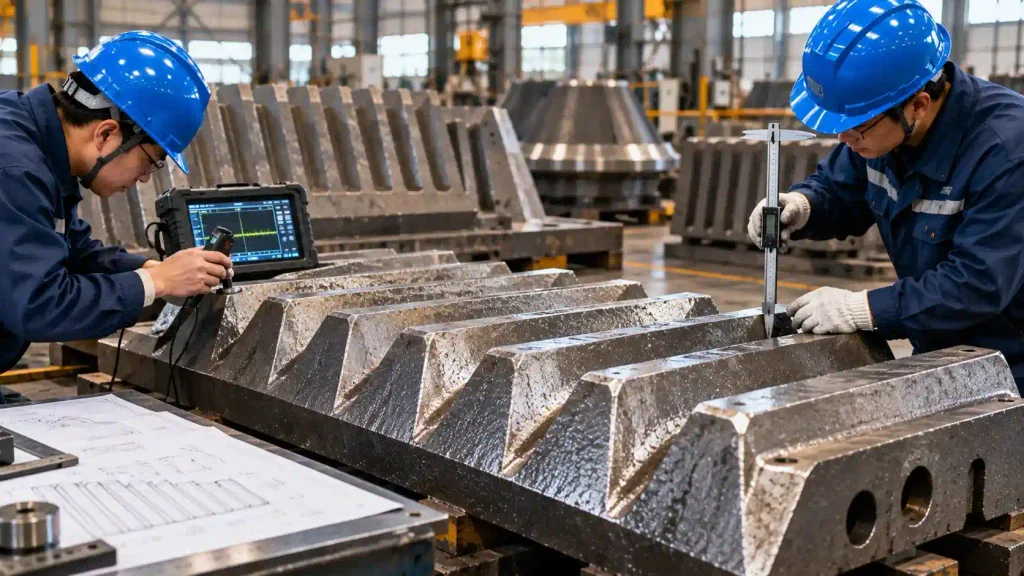
Two jaw plates manufactured from nominally the same manganese steel grade may not deliver identical performance.
The reason is that chemical composition alone does not determine casting quality.
Manufacturing variables include:
Melting and composition control
The steel must meet the required chemical specification.
Mould design and solidification
The casting process must account for component geometry, feeding, shrinkage, and solidification behavior.
Heat treatment
For austenitic manganese steel, appropriate solution treatment and cooling are important to achieve the intended microstructure.
Dimensional accuracy
Mounting surfaces, locating features, and critical dimensions must be compatible with the crusher.
Inspection
Applicable inspection may include chemical analysis, mechanical testing, dimensional checks, and non-destructive examination.
Internal defects, unsuitable microstructures, or dimensional inaccuracies can reduce reliability even when the component appears acceptable from the outside.
This is why consistent manufacturing process control matters for long-term wear performance.
A common assumption is that thicker wear parts automatically last longer.
In reality, adding material without considering crushing geometry can produce disappointing results.
The shape of a wear part affects how material enters, moves through, and exits the crushing chamber.
Jaw plate geometry influences gripping behavior, crushing action, and wear distribution.
Different tooth profiles may be appropriate for different feed materials and crushing duties.
Mantle and concave geometry affects:
An optimized liner should maintain acceptable crushing performance throughout its intended wear life.
When wear is concentrated in one area, a manufacturer can evaluate whether the existing geometry or material distribution is appropriate.
However, profile modifications require engineering review to avoid reducing capacity, creating interference, or increasing loads on the crusher.
The goal is not simply to add more metal. It is to use the available wear material more effectively.
Track the total cost and production tonnage of each wear-part campaign.
Compare replacement options under similar operating conditions.
Record wear measurements, photographs, operating hours, throughput, and relevant crusher settings.
Consistent records make it easier to identify abnormal wear and estimate replacement timing.
Provide the wear-part manufacturer with information about ore or rock characteristics and the observed failure mode.
Material optimization should address the real problem rather than rely on generic claims of superior hardness.
Uneven wear, reduced feed acceptance, or declining throughput may indicate that the current wear profile is unsuitable.
Consider engineering evaluation of the chamber or tooth profile.
Coordinate wear-part replacement with planned shutdowns where possible.
Avoid operating beyond approved wear limits merely to gain additional production hours.
For applications with recurring wear problems, custom manufacturing may provide options involving:
These options should be evaluated using technical data and, where practical, controlled operating comparisons.
LANGTENG focuses on heavy industrial wear parts and custom components for demanding mining and aggregate applications.
Our relevant product scope includes:
Jaw Crusher Wear Parts
Fixed jaw plates, movable jaw plates, and related wear components.
Cone Crusher Wear Parts
Mantles, concaves, and custom wear liners.
Gyratory Crusher Wear Parts
Mantles, concave segments, and other specified replacement components.
Impact Crusher Wear Parts
Blow bars, impact plates, and wear liners.
Depending on the approved technical requirements, a custom wear-part project may involve:
For equipment operating under unusually abrasive or demanding conditions, manufacturing improvements should be considered alongside crusher settings, feed conditions, and maintenance practices.
No material or design change can guarantee longer wear life in every application.
To evaluate a custom replacement or wear-life improvement project, customers should prepare the following information:
| Required Information | Engineering Purpose |
| Crusher brand and model | Identify equipment configuration |
| Wear part name and part number | Establish component scope |
| Technical drawings or dimensions | Confirm geometry and interfaces |
| Current material specification | Evaluate material suitability |
| Ore or rock type | Understand wear environment |
| Feed size and operating conditions | Assess loading conditions |
| Current wear life | Establish baseline performance |
| Wear photographs | Identify wear patterns |
| Tons processed per wear campaign | Calculate wear cost per ton |
| Main failure problem | Define improvement objective |
For example, a customer experiencing premature jaw plate cracking requires a different engineering approach from one experiencing rapid abrasive wear.
Providing accurate operating information helps the manufacturer identify suitable options.
There is no fixed replacement interval suitable for every crusher.
Replacement timing depends on the equipment design, material being processed, operating conditions, wear profile, and manufacturer-specified limits.
Measure cost per ton, monitor wear, select suitable materials, maintain correct crushing conditions, and plan replacements before critical failure.
For recurring problems, evaluate material or geometry customization.
No. Excessive hardness without sufficient toughness may increase cracking or breakage risks.
The best material depends on abrasion, impact loading, and the specific crushing application.
They may perform better when material selection or geometry changes address a confirmed wear problem.
However, improved service life must be demonstrated under comparable operating conditions.
Mantle and concave replacement should follow the crusher manufacturer's guidance and an assessment of the condition and compatibility of both components.
Replacing one liner while retaining a severely worn mating liner may create unfavorable chamber geometry.
Potentially. Existing samples and dimensional measurements can support reverse engineering.
However, critical dimensions, material specifications, mounting interfaces, and design requirements must be verified before production.
The objective of crusher wear-part management is not to achieve the longest possible operating time at any cost.
It is to maintain reliable crushing performance while minimizing the total wear-related cost per ton of material processed.
The most effective approach combines:
For mining and aggregate operators, understanding the relationship between wear life, productivity, and manufacturing quality can lead to better purchasing and maintenance decisions.
Looking for Custom Crusher Wear Parts?
LANGTENG supports custom manufacturing inquiries for jaw plates, mantles, concaves, blow bars, and other heavy-duty crusher wear components.
Share your crusher model, drawings, existing material specifications, and wear problems to discuss suitable replacement or customization options.
Request a Custom Crusher Wear Parts Quote
@ 2025-2026 Langteng Machinery