
Time: Oct 28 2026 Views: 6
An industrial manufacturer's guide to custom open-die forgings, material selection, precision machining and quality inspection.
Heavy industrial equipment depends on large metal components capable of transmitting torque, supporting substantial loads and operating reliably over extended service periods.
In mining machinery, industrial gearboxes, steel mills, cement plants and oilfield equipment, these components often include heavy-duty shafts, large rings and gear blanks.
Many of these parts begin as open-die forgings.
But selecting open-die forging is only the beginning of the manufacturing process. The performance of a finished component also depends on steel selection, forging practice, heat treatment, machining accuracy and inspection.
For equipment manufacturers and replacement-parts buyers, understanding these factors can help prevent material mismatches, dimensional problems and unnecessary manufacturing costs.
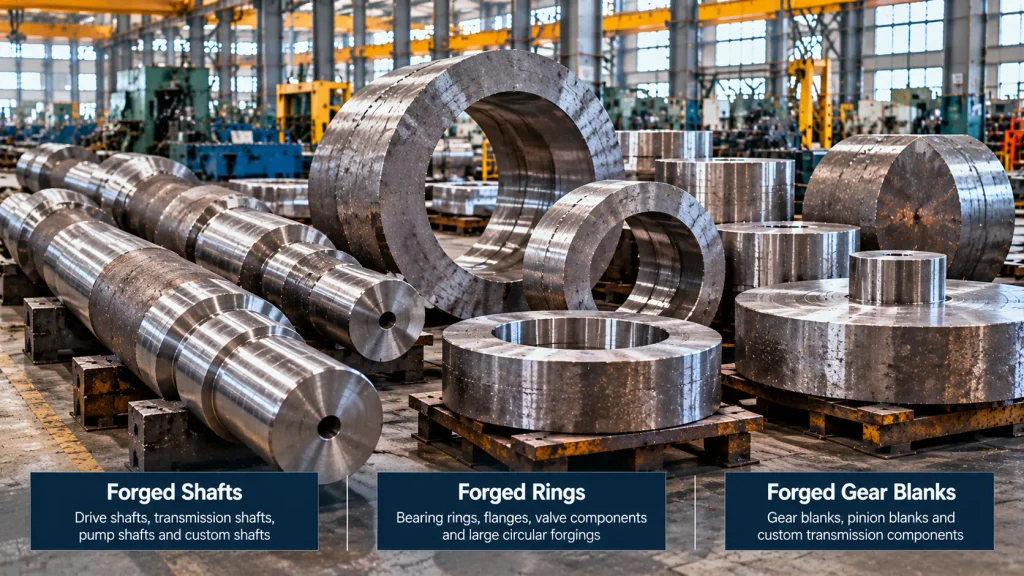
This guide examines three important product categories—forged shafts, forged rings and forged gear blanks—from the perspective of a custom heavy industrial components manufacturer.
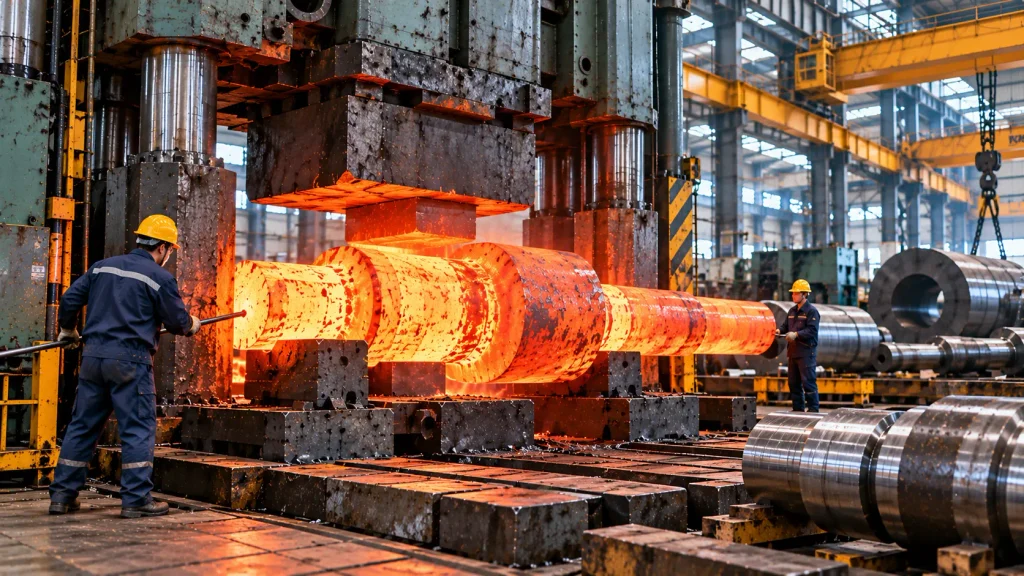
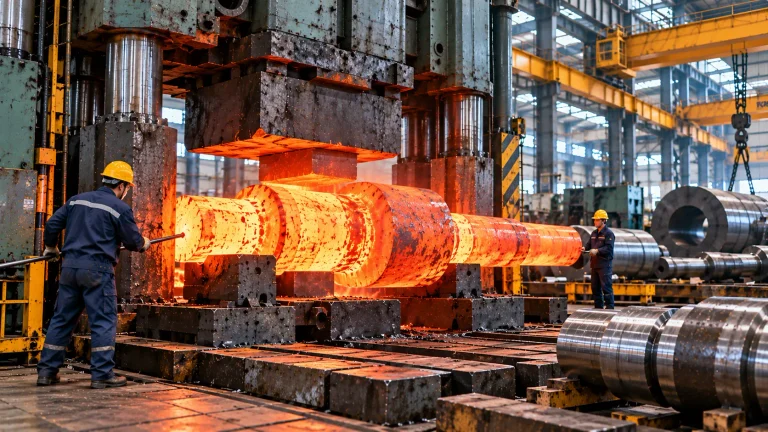
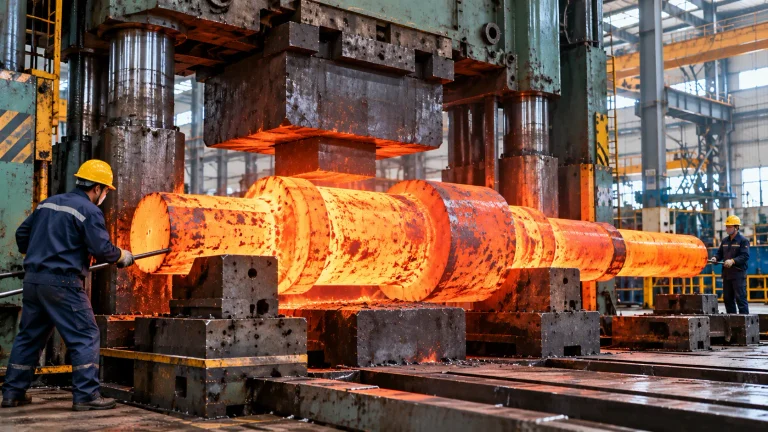
Open-die forging is a metal-forming process in which heated steel is progressively compressed between dies that do not fully enclose the workpiece.
Unlike closed-die forging, open-die forging does not require a dedicated die cavity for every component shape.
This makes it particularly useful for large components, custom dimensions and relatively small production quantities.
Typical products include:
The process can produce substantial metal sections with controlled geometry and specified mechanical properties.
However, the benefits depend on the material, deformation history, heat treatment and final inspection requirements.
A forged component should never be evaluated solely by its manufacturing method.
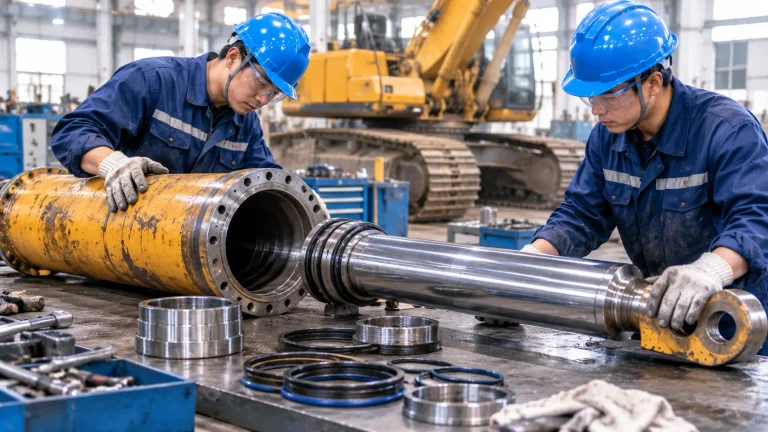
Forged shafts are among the most important applications of open-die forging in heavy machinery.
They are widely used in industrial transmission systems where substantial torque and repeated mechanical loads must be transferred through rotating components.
Typical applications include:
| Equipment | Forged Shaft Application |
| Industrial Gearboxes | Input shafts, output shafts, transmission shafts |
| Mining Equipment | Drive shafts and heavy-duty mechanical components |
| Cement Machinery | Gearbox shafts and rotary equipment drive shafts |
| Steel Rolling Mills | Mill drive shafts and transmission components |
| Oilfield Equipment | Pump drive shafts and gearbox shafts |
| Marine Machinery | Selected engine and propulsion-system shaft components |
The required design depends on the equipment's torque, rotational speed, bearing arrangement and operating environment.
A heavy-duty shaft may require a combination of:
Open-die forging provides a manufacturing route for producing large shaft blanks that can subsequently be heat-treated and precision-machined.
For stepped shafts, manufacturers can also shape the forging closer to the required geometry, potentially reducing material removal compared with machining the entire component from a constant-diameter blank.
1. Material selection
Common shaft material families include carbon steels and low-alloy steels such as 4140, 42CrMo4 and 4340.
The appropriate grade depends on section size, strength, toughness and heat-treatment requirements.
2. Forging deformation
The forging plan must account for the starting material, deformation sequence, temperature and final dimensions.
3. Heat treatment
Large shafts may require quenching and tempering or other specified treatments.
Achieving the required properties throughout a heavy cross-section can be challenging.
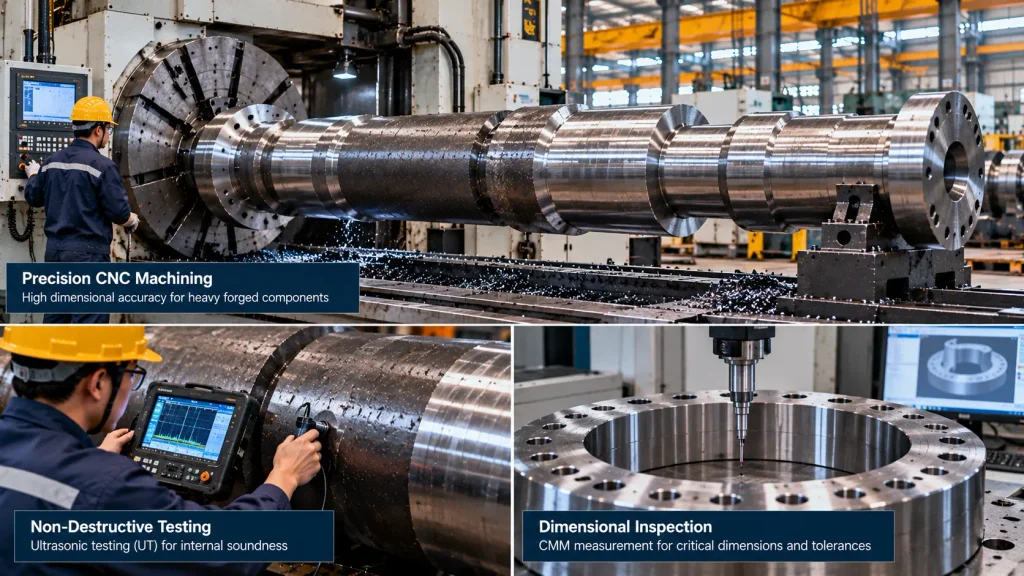
4. Precision machining
Important dimensions may include bearing journal diameters, coupling interfaces, straightness, concentricity and runout.
5. Quality inspection
Depending on the specification, testing may include ultrasonic examination, mechanical testing and dimensional verification.
For custom forged shafts, customers should provide the complete component drawing rather than only the overall diameter and length.
Bearing fits, shoulders, keyways, splines and heat-treatment requirements often determine whether the finished shaft can be installed successfully.
Large forged rings are another important category of heavy industrial components.
They can be used in equipment requiring substantial circular components, load-bearing structures or precision-machined interfaces.
Depending on equipment design, forged rings may be used for:
Large ring products may be manufactured using open-die forging, seamless ring rolling or a combination of processes.
These manufacturing routes should be distinguished when specifying a purchase order.
Large industrial rings may require:
For equipment requiring high dimensional accuracy, the forging is typically followed by machining.
Ring geometry
The manufacturer must control outside diameter, inside diameter, height and cross-sectional dimensions.
Material utilization
The initial blank dimensions and manufacturing route affect material consumption.
Heat-treatment distortion
Large rings can change shape during thermal processing.
Machining allowance
Sufficient stock must remain for finish machining without creating excessive waste.
Dimensional inspection
Roundness, flatness, concentricity and other relevant characteristics must be verified.
The decision depends on the required dimensions, section geometry, material and available equipment.
Seamless ring rolling can be efficient for many large annular components, while open-die forging may be appropriate for certain heavy or nonstandard ring geometries.
A manufacturer should recommend the route after reviewing the finished drawing.
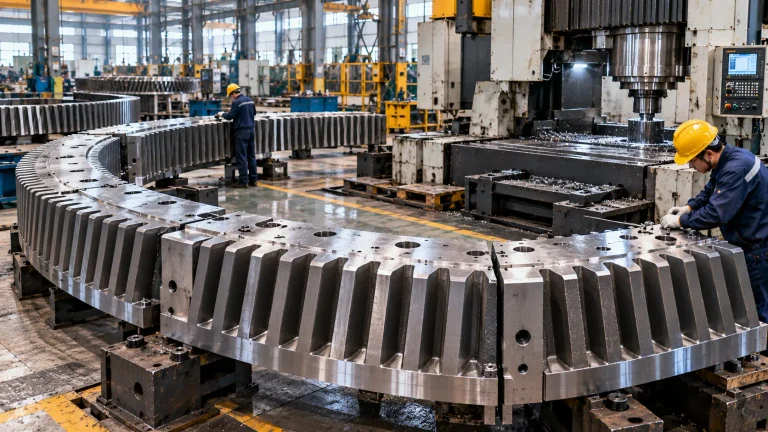
Large industrial gears are critical components in mining, cement production, steel manufacturing and other heavy-duty operations.
Before gear teeth are cut, many gears begin as forged blanks.
These may include:
| Equipment | Typical Gear Component |
| Mining Gearboxes | Large gears and pinions |
| Cement Plant Drives | Gearbox gears and drive pinions |
| Steel Rolling Mills | Heavy-duty transmission gears |
| Industrial Reducers | Gear wheels and pinion shafts |
| Oilfield Machinery | Gearbox gears and drive components |
Some exceptionally large gears, including many girth gears, are manufactured from cast steel rather than forgings.
The choice depends on gear size, design, material requirements and manufacturing feasibility.
Gear performance depends on more than tooth cutting accuracy.
The initial material and manufacturing process influence the blank's mechanical properties and suitability for subsequent heat treatment.
A gear blank must provide an appropriate foundation for:
Material properties
The gear blank must meet the specified strength and toughness requirements.
Heat-treatment condition
The required condition depends on the gear design and subsequent tooth-hardening process.
Machining stability
The blank must be suitable for machining without unacceptable distortion.
Dimensional accuracy
Bore dimensions, reference faces and other datums influence subsequent gear cutting.
Inspection
Material soundness and relevant dimensions must be verified before additional processing.
A buyer orders a gear blank based only on the outside diameter, thickness and steel grade.
After delivery, the gear manufacturer discovers that the blank does not have sufficient machining allowance or that its heat-treatment condition is unsuitable for the planned gear-cutting sequence.
The result may be additional machining, process changes or rejection of the blank.
Manufacturer's recommendation: Coordinate forging requirements with the downstream gear manufacturer before production begins.
The correct material depends on the component's mechanical function and operating conditions.
Different forged products may require different combinations of strength, toughness, hardness and machinability.
| Material Family | Typical Characteristics | Potential Applications |
| Carbon Steel | General mechanical properties and machinability | Large general-purpose forgings |
| 4140 / 42CrMo4 Alloy Steel | Strength and toughness after appropriate heat treatment | Shafts and mechanical transmission parts |
| 4340 Alloy Steel | High-strength applications with controlled heat treatment | Selected heavy-duty shafts |
| Stainless Steel | Corrosion resistance depending on grade | Rings and specialized equipment parts |
| Project-Specific Alloy Steel | Properties selected for particular loading or temperature conditions | Custom industrial components |
These are representative material families. Final selection must follow the applicable drawing, product standard and engineering requirements.
No.
A shaft or gear blank requires a suitable balance of mechanical properties.
Increasing hardness without considering toughness, fatigue behavior and the intended heat-treatment process may create additional risks.
Material selection should be based on the component's actual service conditions.
A custom open-die forging project typically involves several coordinated manufacturing stages.
The manufacturer reviews the drawing, material specification, dimensions, quantity and inspection requirements.
At this stage, the team should identify potential manufacturing risks.
The manufacturer determines the starting material, forging sequence, heating requirements and machining allowance.
The plan must be appropriate for the component's geometry and specified properties.
Heated steel is deformed using a forging press or hammer.
The material is progressively shaped into the required blank.
The forged component receives the specified thermal treatment.
This stage is important for achieving the required material condition.
Rough machining establishes basic reference surfaces and removes excess material.
Ultrasonic testing and other required examinations may be performed to evaluate material soundness.
The inspection method, coverage and acceptance criteria must be specified.
The component is machined to the required final or intermediate dimensions.
For shafts, this may involve bearing journals and coupling interfaces.
For rings, it may involve bores, faces and diameters.
For gear blanks, it may involve bores, mounting faces and machining datums.
The finished component is checked against the purchase requirements.
Documentation may include material certificates, mechanical test reports, NDT records and dimensional inspection reports.
A high-quality forging is not defined by appearance alone.
Buyers should pay attention to several important factors.
The component should be traceable to its specified material and relevant production records.
Large forgings may require ultrasonic inspection to detect unacceptable internal discontinuities.
Specified tensile strength, yield strength, elongation, impact properties or hardness must be verified where required.
The heat-treatment process must support the required final material condition.
The finished part must meet the dimensional and geometric requirements of the drawing.
Acceptance should be based on defined inspection criteria rather than unsupported claims about quality.
For heavy industrial components, these requirements can be particularly important because replacement failures may lead to costly equipment downtime.
The following is an illustrative engineering scenario, not a documented customer project.
A mining equipment maintenance company needs to replace a large gearbox output shaft.
The original equipment manufacturer no longer supplies the component within the required project schedule.
The customer provides an old shaft and partial drawings.
The replacement manufacturer must verify:
After engineering verification, the component may be produced through:
Custom forging can support replacement projects where standard components are unavailable.
However, reverse engineering must establish the correct functional requirements, not simply copy the visible dimensions of a worn component.
The following is an illustrative engineering scenario, not a documented customer project.
An industrial gearbox manufacturer requires a large gear blank for a low-volume custom reducer.
The gear teeth will be machined and heat-treated after the blank is supplied.
The forging supplier must coordinate with the gear manufacturer regarding:
The forging manufacturer produces a blank to the approved intermediate drawing.
The gear manufacturer then completes the required tooth machining, additional heat treatment and final inspection.
Clear coordination between the forging supplier and the downstream gear manufacturer helps reduce dimensional and process incompatibilities.
The lowest forging quotation does not necessarily produce the lowest total component cost.
Several decisions can affect manufacturing efficiency.
Some components are better suited to casting, closed-die forging, ring rolling or machining from stock.
Open-die forging should be selected when it offers a technical and commercial advantage.
Excessive machining allowance increases material removal and processing time.
Insufficient allowance can make the blank unusable.
An incomplete material specification can lead to unnecessary clarification, rework or unsuitable procurement.
The sequence of heat treatment and machining affects distortion, stock removal and final accuracy.
Late changes to inspection requirements may create additional cost or make required testing difficult.
For replacement components, dimensional compatibility, documentation and delivery reliability may be more important than a small difference in the initial purchase price.
A complete RFQ helps manufacturers evaluate feasibility and provide more accurate quotations.
| Required Information | Purpose |
| Component name and application | Understand mechanical function |
| Technical drawing | Establish geometry and tolerances |
| Material specification | Define steel requirements |
| Forging weight and dimensions | Assess production capacity |
| Heat-treatment requirements | Determine processing route |
| Machining scope | Clarify blank or finished-part supply |
| Mechanical properties | Establish acceptance criteria |
| NDT requirements | Define material inspection |
| Quantity | Plan production |
| Delivery schedule | Evaluate lead time |
| Documentation requirements | Establish traceability and acceptance |
For replacement parts, photographs and existing samples can provide useful additional information, but they do not replace engineering verification.
When sourcing heavy-duty forgings, buyers should evaluate more than forging equipment size.
A suitable manufacturer should be able to address:
Forging feasibility: Can the required geometry and dimensions be produced?
Material requirements: Can the specified steel grade and properties be achieved?
Heat treatment: Can the component receive the required treatment?
Machining capability: Can critical dimensions be finished accurately?
Inspection: Can the specified testing and documentation be provided?
Engineering communication: Can the supplier identify risks before manufacturing begins?
The best manufacturing arrangement may involve a coordinated supply chain of forging, heat treatment, machining and testing specialists.
What matters is that responsibilities, technical requirements and quality controls are clearly defined.
LANGTENG focuses on custom heavy industrial components produced through forging, casting and precision machining.
Relevant product categories include:
Heavy-duty shaft blanks and machined shafts for industrial transmissions, mining equipment and other mechanical systems.
Large ring blanks and machined circular components manufactured according to approved drawings and material requirements.
Custom gear and pinion blanks for subsequent gear manufacturing or integrated machining projects, subject to technical feasibility.
Our manufacturing approach begins with understanding the component's application, geometry, material requirements and inspection criteria.
For custom projects, the production route should be selected based on the finished component's engineering requirements rather than the forging process alone.
Typical products include large shafts, stepped shafts, rings, discs, blocks, hollow components and gear blanks.
Yes. Open-die forging can be suitable for low-volume and one-off heavy components, depending on size, material and manufacturing economics.
No. Gear blanks may be forged, cast or manufactured through other routes depending on gear design and requirements.
A forged shaft describes a shaft produced using a forging process before final machining.
A machined shaft describes the machining operation or finished condition. A shaft may be both forged and machined.
Yes. Seamless forged or rolled rings can be produced without a welded circumferential joint, depending on the manufacturing process.
Customers should provide drawings, material specifications, dimensions, quantity, heat-treatment requirements, machining scope and inspection criteria.
Yes, when the manufacturing arrangement includes the required machining, inspection and documentation capabilities.
Open-die forging plays an important role in manufacturing large, custom components for heavy industrial machinery.
Forged shafts, forged rings and gear blanks illustrate three different applications of the process, each with its own engineering and manufacturing requirements.
For buyers, the most important question is not simply whether a component can be forged.
It is whether the selected manufacturing route can consistently deliver the required material properties, geometry, dimensional accuracy and inspection results.
By reviewing these requirements before production, equipment manufacturers and maintenance companies can make better decisions when sourcing custom heavy-duty components.
Looking for Custom Forged Components?
LANGTENG supports inquiries for custom forged shafts, rings, gear blanks and heavy-duty machined components.
Send your drawings, material specifications, dimensions and inspection requirements to discuss manufacturing feasibility.
Request a Custom Forging Quote
@ 2025-2026 Langteng Machinery