
Time: Oct 28 2026 Views: 4
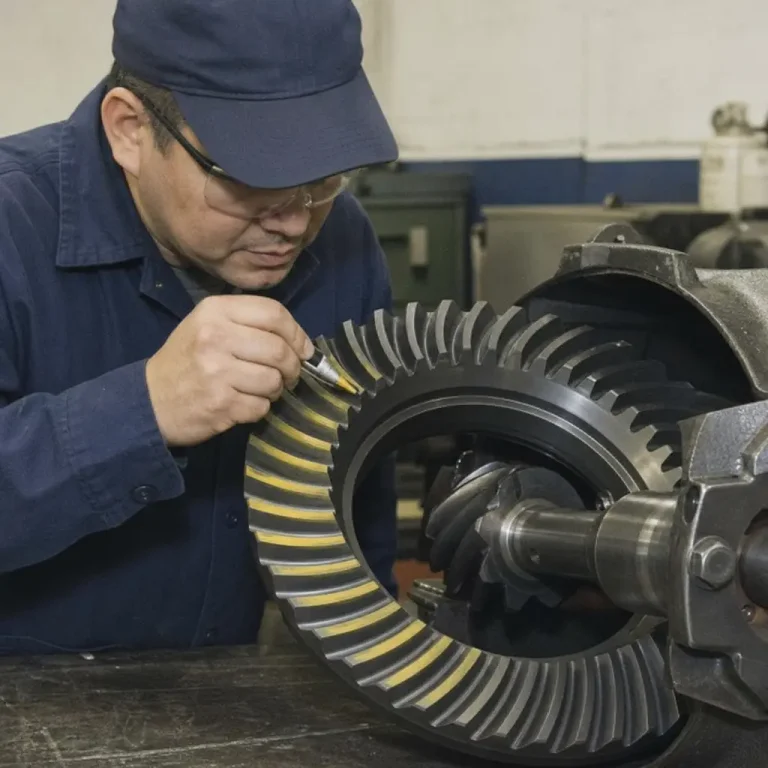
Heavy machinery depends on shafts to transmit torque, support rotating components, and withstand demanding operating loads. From mining crushers and industrial gearboxes to cement mills and steel rolling equipment, shaft performance directly affects equipment reliability, power transmission, and maintenance costs.
Unlike standard shafts used in smaller mechanical systems, heavy-duty industrial shafts often require large diameters, specialized alloy steels, controlled heat treatment, and precision machining.
For equipment manufacturers and maintenance teams, sourcing a replacement shaft is not simply a matter of matching its dimensions. Material properties, load conditions, fatigue resistance, bearing fits, and installation compatibility must also be considered.
At LANGTENG, our custom industrial component manufacturing focuses on heavy-duty shafts and other engineered parts produced to customer drawings and application requirements.
This guide explains the major types of forged shafts used in heavy machinery, their manufacturing processes, and the factors buyers should evaluate when sourcing custom replacements.
Industrial shafts operate under combinations of torsion, bending, axial loads, vibration, and cyclic stress.
In heavy equipment, these conditions become particularly demanding because shafts may transmit substantial torque while supporting large gears, bearings, couplings, or rotating assemblies.
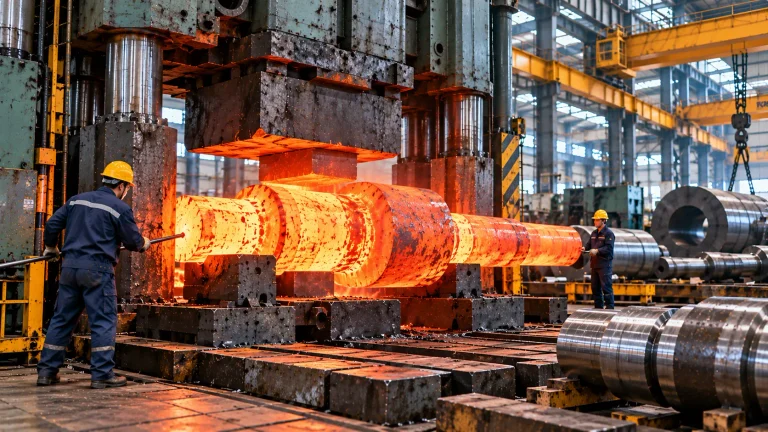
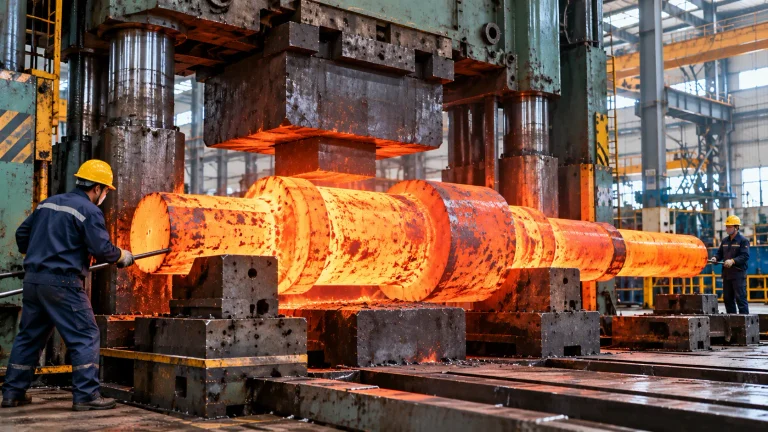
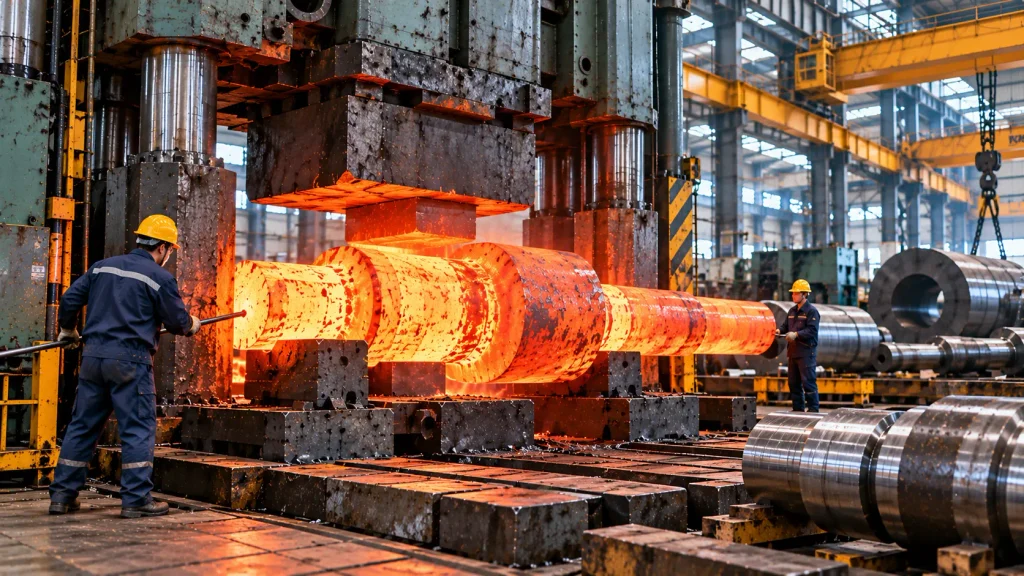
Open-die forging is one manufacturing route used to produce large steel shaft blanks.
During forging, heated steel is plastically deformed under controlled compressive forces. With appropriate process design, forging can improve internal soundness and develop a suitable worked structure compared with the starting ingot.
However, final shaft performance also depends on steel cleanliness, forging reduction, heat treatment, machining, and inspection.
The goal is not simply to produce a strong steel component. It is to manufacture a shaft that performs reliably within the complete mechanical assembly.
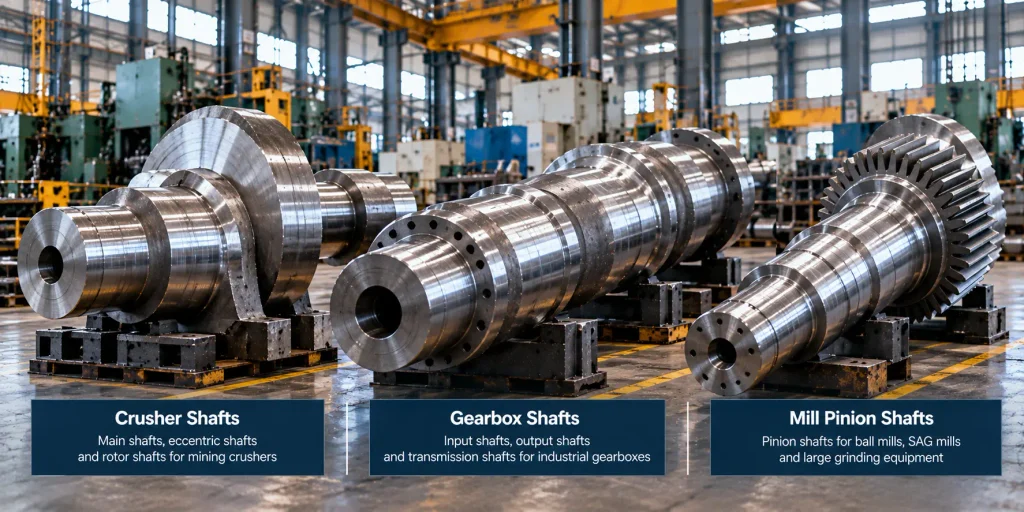
Different industries require different shaft designs.
Understanding the equipment application is essential when selecting materials, manufacturing methods, and inspection requirements.
Mining crushers operate under severe mechanical loading, including impact, vibration, and repeated crushing forces.
Depending on crusher design, major shaft components may include:
A crusher main shaft must provide adequate strength while maintaining compatibility with bearings, bushings, and other assembled components.
For eccentric shafts, dimensional accuracy and the relationship between eccentric surfaces and bearing journals are particularly important.
Manufacturing considerations:
For replacement projects, the original equipment drawing, component measurements, and operating history help establish manufacturing requirements.
Heavy industrial gearboxes are used in mining, cement production, metallurgy, material handling, and power transmission systems.
Their shafts transmit torque between gears, bearings, couplings, and driven equipment.
Common components include:
Industrial gearbox shafts often feature multiple stepped diameters, precision bearing journals, gear mounting surfaces, and coupling connections.
The main manufacturing challenge is maintaining dimensional and geometric accuracy across these functional interfaces.
For a replacement gearbox shaft, even a small deviation in bearing fit, gear position, or shaft alignment can affect the operation of the entire gearbox.
Ball mills and SAG mills use heavy-duty drive systems to rotate large grinding equipment.
Depending on the transmission arrangement, a mill pinion shaft may be manufactured as a separate shaft or as an integral gear-and-shaft component.
These components operate under high torque and repeated loading.
Critical considerations include:
Where a pinion gear is integral with the shaft, gear manufacturing and heat-treatment requirements must be coordinated with the shaft design.
Rotary kilns are widely used in cement production, mineral processing, and other thermal industries.
Support roller shafts carry significant radial loads while operating within a roller-and-bearing assembly.
Manufacturing requirements may include:
For replacement projects, the shaft should be evaluated together with the roller, bearings, and housing.
Steel rolling mills use large shafts and spindles to transmit power under demanding operating conditions.
Depending on the equipment design, these components may experience high torque, shock loading, and frequent changes in operating load.
Manufacturing considerations include material toughness, fatigue performance, coupling geometry, and accurate machining of critical surfaces.
Material selection is one of the most important decisions in custom shaft manufacturing.
A steel grade that performs well in one application may not be appropriate for another.
| Material | General Characteristics | Typical Application Considerations |
| AISI 1045 / C45 | Medium-carbon steel with useful strength and machinability | Industrial shafts with moderate mechanical demands |
| AISI 4140 / 42CrMo4 | Chromium-molybdenum alloy steel offering a useful strength-toughness balance | Gearbox shafts, pinion shafts, heavy-duty transmission components |
| AISI 4340 | Nickel-chromium-molybdenum alloy steel with high strength and toughness potential | Highly loaded shafts requiring appropriate heat treatment |
| 34CrNiMo6 | Alloy steel commonly specified for demanding mechanical components | Heavy transmission shafts and large industrial components |
| Application-specific grades | Selected according to required properties and standards | Special operating environments and engineered replacements |
Material grades shown are illustrative. Equivalent designations are not automatically interchangeable; chemical composition, product standards, heat treatment, section size, and required mechanical properties must be verified.
Forging alone does not determine the final mechanical properties of a shaft.
Depending on the material and application, heat-treatment processes may include normalizing, quenching and tempering, or other specified treatments.
The objectives may include achieving the required strength, toughness, hardness, and structural uniformity.
Large-diameter shafts require particular attention because the properties at the center of a thick section may differ from those near the surface.
For this reason, the required mechanical properties, test locations, and acceptance criteria should be agreed upon before production.
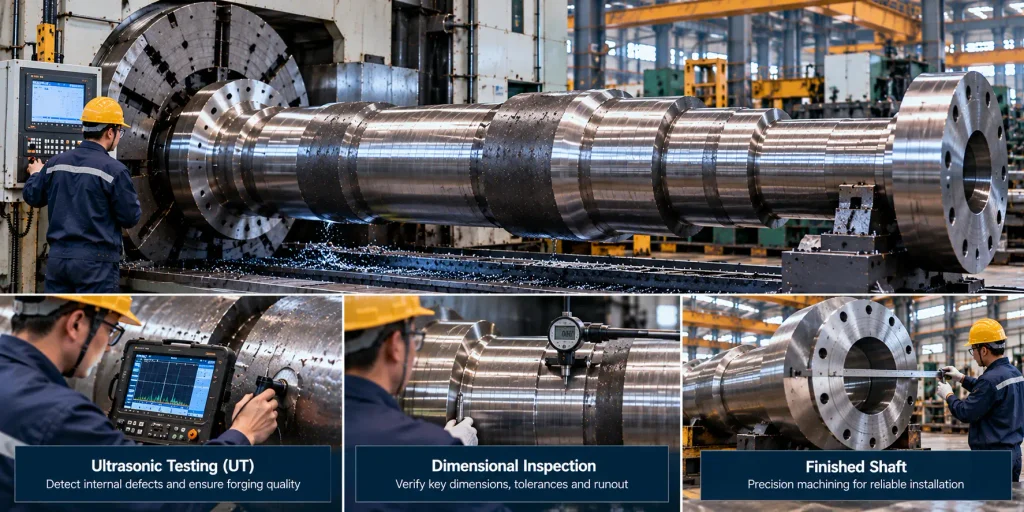
The manufacturing route depends on shaft size, material, geometry, and customer specifications.
A typical process for a large forged industrial shaft includes the following stages.
Before manufacturing begins, the technical team reviews:
For replacement parts, the review may also consider available original drawings, measurements, and the operating condition of the equipment.
A suitable steel ingot or starting stock is selected according to the approved manufacturing plan.
For large custom shafts, open-die forging may be used to create the required blank geometry.
Forging operations can include upsetting, drawing out, and local shaping.
The forging process must provide sufficient working of the material while accounting for the intended final geometry and subsequent machining allowance.
After forging, the shaft blank undergoes the specified heat-treatment process.
Process parameters depend on material grade, section size, and the mechanical properties required.
Temperature control, soaking, cooling, and subsequent testing are important for large-section components.
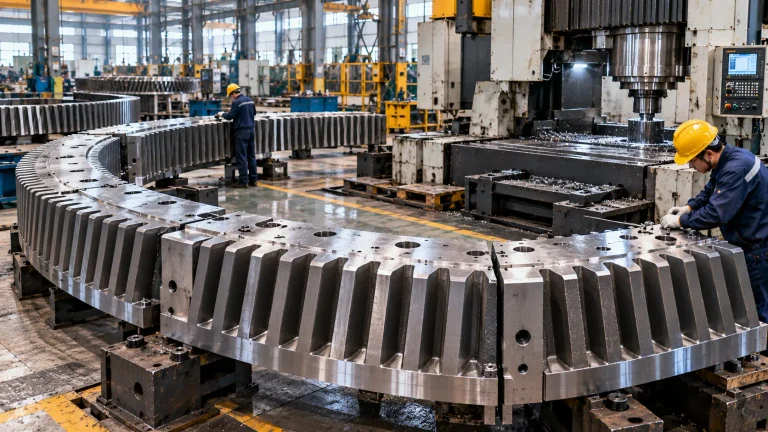
Rough machining removes excess material and establishes the principal shaft geometry.
Operations may include:
At this stage, the component may also undergo intermediate inspection.
Final machining establishes the critical functional dimensions.
Depending on the shaft design, operations may include:
Particular attention is given to bearing fits, concentricity, runout, and surface finish where these affect assembly performance.
Inspection requirements should reflect the shaft's operating conditions and the agreed manufacturing specification.
Typical verification methods include dimensional inspection, mechanical testing, and non-destructive testing.
Where required by the purchase specification, the manufacturing package may include material certificates, heat-treatment records, inspection reports, and dimensional verification documents.
Large shafts also require suitable handling, corrosion protection, and transport supports to protect machined surfaces during delivery.
A heavy-duty shaft can meet its nominal dimensions and still create problems during installation or operation.
For this reason, quality control must consider more than overall length and diameter.
Material traceability helps connect the finished shaft to its source material and manufacturing records.
Depending on project requirements, documentation may include:
Ultrasonic testing (UT) is commonly specified for large forgings to examine internal discontinuities.
The examination procedure, coverage, sensitivity, and acceptance criteria should follow the applicable specification.
Surface examination methods may be specified for suitable materials and geometries.
Magnetic particle testing is used for ferromagnetic materials, while penetrant testing can identify surface-breaking indications on appropriately prepared surfaces.
Important shaft characteristics may include:
The required inspection method should be selected according to the size and tolerance of the component.
For large shafts, appropriate measuring instruments and inspection setups are essential.
Standard shafts are suitable when dimensions, materials, and mechanical requirements match an established product specification.
However, heavy industrial equipment frequently uses non-standard components.
Custom manufacturing becomes particularly important when:
Consider a heavy industrial gearbox requiring a replacement output shaft.
The existing shaft includes multiple bearing journals, a keyed coupling connection, and a gear mounting section.
A replacement cannot be specified using only overall length and maximum diameter.
The manufacturer must also confirm the relationship between bearing seats, gear location, shoulder dimensions, keyway geometry, and other assembly interfaces.
Material and heat-treatment requirements must be reviewed against the original design and operating loads.
In this type of project, manufacturing success depends on both the component's mechanical properties and its compatibility with the existing gearbox.
This is an illustrative manufacturing scenario, not a claim about a completed LANGTENG project.
The price of a large forged shaft depends on several technical factors.
Material grade: Alloy composition, steel cleanliness, and material certification requirements influence cost.
Shaft size and weight: Larger components require more raw material, handling capacity, and machine time.
Forging complexity: Stepped geometries and specialized forging requirements affect production planning.
Heat treatment: Large-section heat treatment and associated testing can influence manufacturing cost and lead time.
Machining requirements: Tight tolerances, long machining lengths, deep holes, splines, and precision bearing surfaces increase processing complexity.
Inspection requirements: Additional non-destructive examination, mechanical testing, and documentation can increase project cost.
For industrial buyers, the lowest purchase price does not necessarily represent the lowest operating cost.
A shaft that causes installation delays, premature failure, or unexpected equipment shutdown can create costs far beyond its original purchase price.
A complete technical inquiry helps the manufacturer evaluate feasibility and prepare a more accurate quotation.
| Required Information | Details |
| Equipment application | Crusher, gearbox, grinding mill, rotary kiln, rolling mill, or other equipment |
| Engineering drawing | Dimensions, tolerances, surface finish, and functional interfaces |
| Material specification | Required steel grade or approved alternatives |
| Heat treatment | Required process and mechanical properties |
| Quantity | Prototype, single replacement, or batch production |
| Inspection | UT, surface examination, dimensional reports, mechanical testing |
| Delivery requirements | Destination, target schedule, packaging requirements |
If an original engineering drawing is unavailable, a physical sample, existing measurements, and assembly information may support a reverse-engineering assessment.
Any proposed material or design modification should be evaluated and approved by the responsible equipment engineer.
When evaluating a forged shaft manufacturer or custom machining supplier, buyers should look beyond the supplier's product photographs.
Important questions include:
Can the manufacturer handle the required dimensions and weight?
Large shafts require appropriate forging, machining, lifting, and inspection capacity.
Can the manufacturer work from detailed engineering drawings?
Heavy equipment shafts often contain critical fits and geometric tolerances that require technical review.
How are forging and machining coordinated?
Machining allowances, heat-treatment distortion, and inspection stages should be considered during process planning.
What quality documentation can be supplied?
The supplier should clearly identify which material, testing, and inspection records are available for the specific order.
Can the supplier support replacement-part manufacturing?
Custom replacement projects often require dimensional verification and close coordination with the customer's maintenance or engineering team.
LANGTENG focuses on custom heavy-duty industrial components manufactured to engineering drawings and application requirements.
Our shaft-related product scope includes:
Through coordinated forging, heat treatment, machining, and inspection requirements, we help customers source engineered shaft components for demanding industrial equipment.
Our manufacturing approach emphasizes:
Application-based material selection — Matching the specified steel and mechanical properties to the operating requirements.
Custom manufacturing — Producing non-standard dimensions and geometries according to approved drawings.
Machining compatibility — Focusing on the functional dimensions required for equipment assembly.
Quality verification — Defining inspection and documentation requirements before manufacturing.
Whether the requirement is a replacement gearbox shaft, a crusher main shaft, or a large forged transmission component, the starting point is a clear understanding of the equipment and its engineering specifications.
A forged shaft describes a component produced from a forged blank. A machined shaft describes a component shaped through machining operations.
These terms are not mutually exclusive. Many heavy-duty forged shafts undergo extensive CNC machining before they are ready for installation.
There is no single best steel for every application. Grades such as 4140, 4340, and 34CrNiMo6 may be considered for demanding shaft applications, but the final choice depends on loads, dimensions, heat treatment, mechanical properties, and applicable standards.
Yes. Custom shaft manufacturing commonly begins with customer drawings that define the geometry, material, tolerances, and inspection requirements.
Manufacturing feasibility must be confirmed against the supplier's equipment capabilities.
In many cases, replacement manufacturing may be feasible using original drawings or sufficiently complete component and assembly measurements.
Material selection, functional interfaces, and engineering approval remain essential.
Open-die forging is a commonly used process for large and non-standard steel shaft blanks. Its suitability depends on the required size, geometry, material, and mechanical properties.
Need a replacement shaft or a custom heavy-duty transmission component?
Send LANGTENG your engineering drawings, material requirements, and equipment application details.
We can review the manufacturing requirements for custom forged and machined shafts used in mining, cement, metallurgy, and heavy industrial equipment.
CTA: Request a Custom Shaft Quote →
@ 2025-2026 Langteng Machinery