
Time: Oct 28 2026 Views: 9
How custom open-die forgings are used in drilling equipment, wellhead systems, industrial valves and heavy-duty oilfield machinery.
Oil and gas equipment operates under demanding mechanical and environmental conditions. High pressure, cyclic loading, vibration, corrosive fluids and remote operating locations place strict requirements on critical metal components.
For many large or custom components, open die forging provides a practical manufacturing route.
Unlike closed-die forging, which forms metal within shaped dies, open-die forging uses repeated deformation between relatively simple tools. This allows manufacturers to produce large shafts, rings, discs, blocks and hollow forgings in a wide range of dimensions.
However, not every oilfield component should be open-die forged.
The correct manufacturing method depends on component geometry, material requirements, production quantity, operating conditions and applicable industry standards.
From a manufacturer's perspective, this guide explains where open-die forging parts are used in oil and gas equipment, how materials are selected, and what customers should consider when ordering custom forgings.
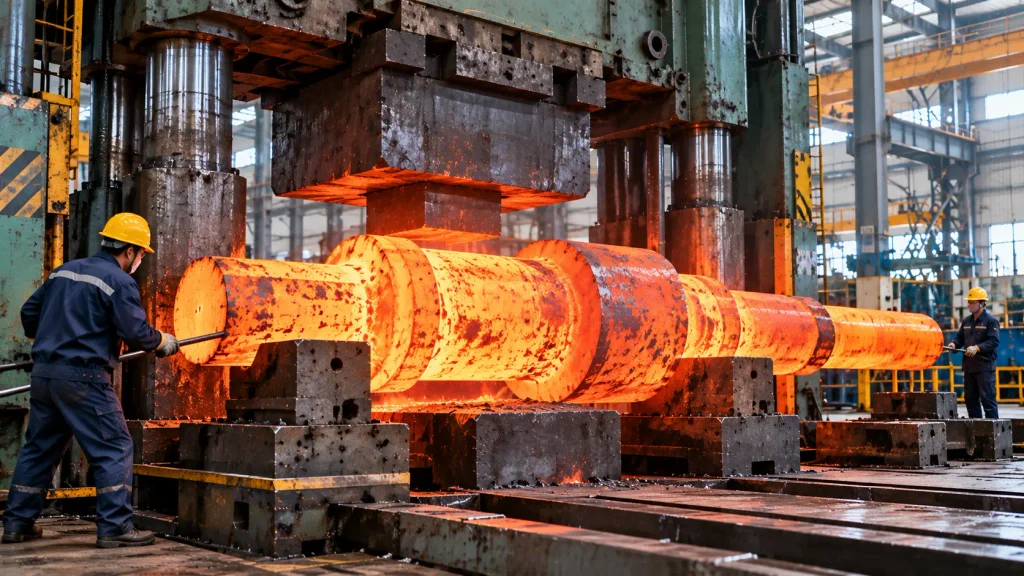
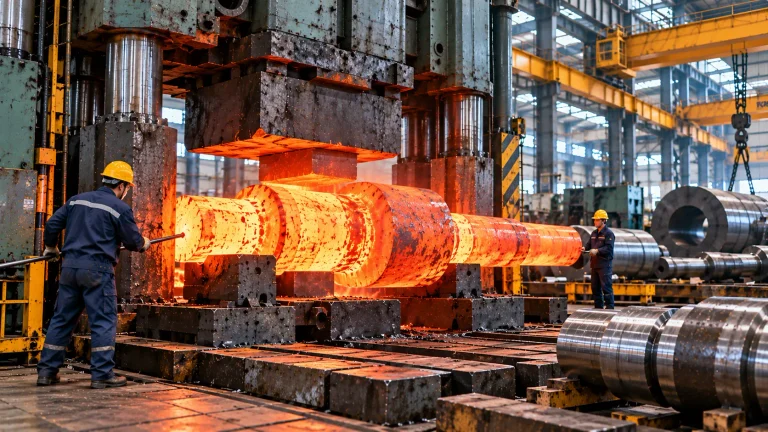
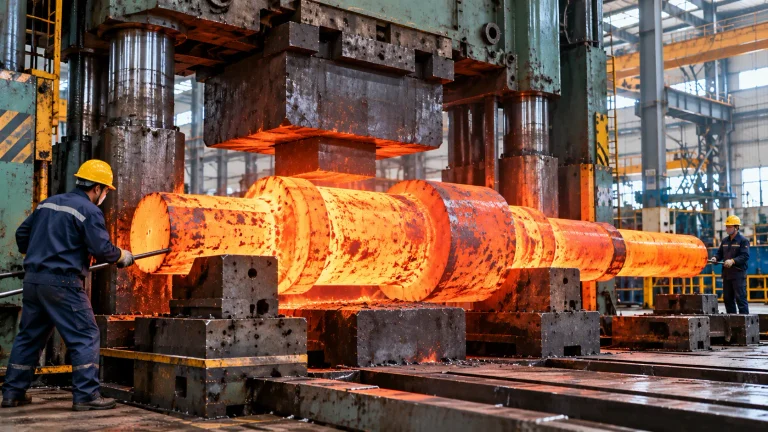
Open-die forging is a metal-forming process in which heated material is compressed between dies that do not completely enclose the workpiece.
The manufacturer progressively shapes the metal through controlled deformation.
Common operations include:
The process is particularly suitable for heavy components that cannot be economically produced using conventional closed dies.
| Factor | Open Die Forging | Closed Die Forging |
| Typical products | Large shafts, rings, discs, blocks | Complex shaped components |
| Production quantity | One-off, small and medium batches | Often economical at higher volumes |
| Tooling | Relatively simple dies and tools | Dedicated shaped dies |
| Component size | Well suited to very large parts | Limited by tooling and equipment |
| Dimensional finish | Usually requires substantial machining | Can achieve closer-to-final shapes |
| Customization | Flexible for changing dimensions | Tooling changes may be expensive |
Open-die forging is therefore attractive for replacement components, specialized machinery and low-volume industrial projects.
It should not automatically be considered superior to closed-die forging, rolled bar, casting or fabrication for every application.
Several categories of oilfield machinery use large forged components.
| Equipment Category | Potential Forged Components | Main Engineering Requirements |
| Drilling Equipment | Shafts, gear blanks, transmission components | Torque, fatigue strength, dimensional accuracy |
| Wellhead Equipment | Forged bodies, rings, connectors, pressure-containing blanks | Pressure integrity, material traceability |
| Blowout Preventer Systems | Selected forged bodies, shafts and structural components | High loads, pressure requirements, inspection |
| Oilfield Pumps | Pump shafts, drive shafts, coupling blanks | Fatigue resistance, alignment, corrosion considerations |
| Oil & Gas Valves | Valve body blanks, bonnets, stems, rings | Pressure, temperature, sealing interfaces |
| Heavy-Duty Gearboxes | Gear shafts, pinion blanks, large gear blanks | Torque transmission, heat treatment, tooth accuracy |
The appropriate production method must be confirmed for each design. Some equipment uses castings, fabricated assemblies, closed-die forgings or other manufacturing routes instead.
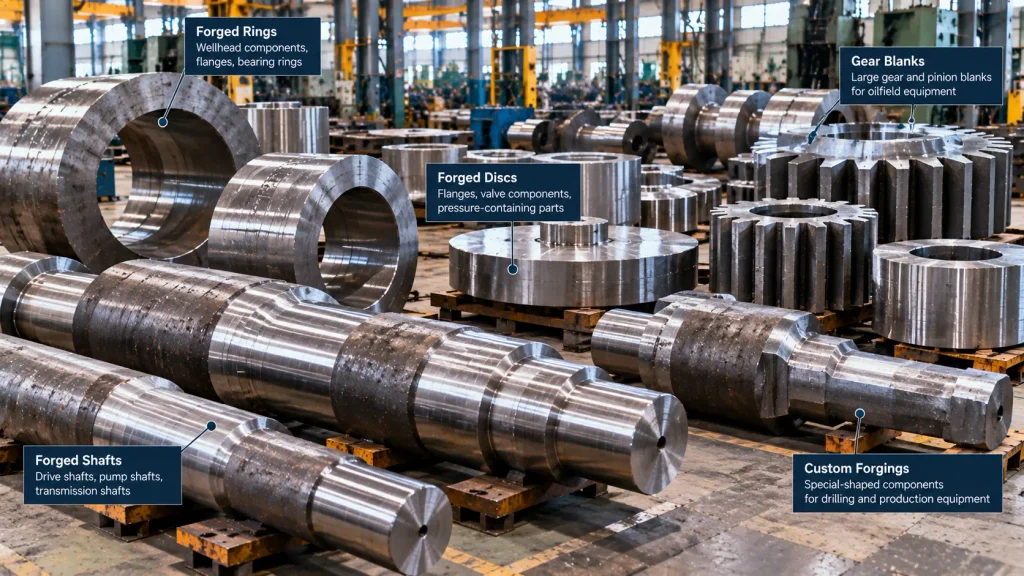
Drilling equipment relies on mechanical drive systems that transmit high torque under repeated operating loads.
Depending on the equipment design, forged shafts may be used in:
A large shaft must withstand a combination of torsion, bending and cyclic loading.
Open-die forging allows manufacturers to produce substantial shaft blanks with specified material properties and dimensions.
For stepped shafts, the initial forging can be shaped to reduce unnecessary machining stock.
Critical factors include:
Material selection: The steel grade must satisfy the design's strength, toughness and heat-treatment requirements.
Forging deformation: The forging plan should provide sufficient working of the material while controlling temperature and geometry.
Heat treatment: Normalizing, quenching and tempering, or other specified treatments may be required.
Machining accuracy: Bearing journals, coupling interfaces and other functional surfaces require controlled dimensions and alignment.
Inspection: Internal soundness, surface condition and dimensional compliance must be verified according to the purchase specification.
A large forged shaft is not complete simply because its outside diameter and length match the drawing.
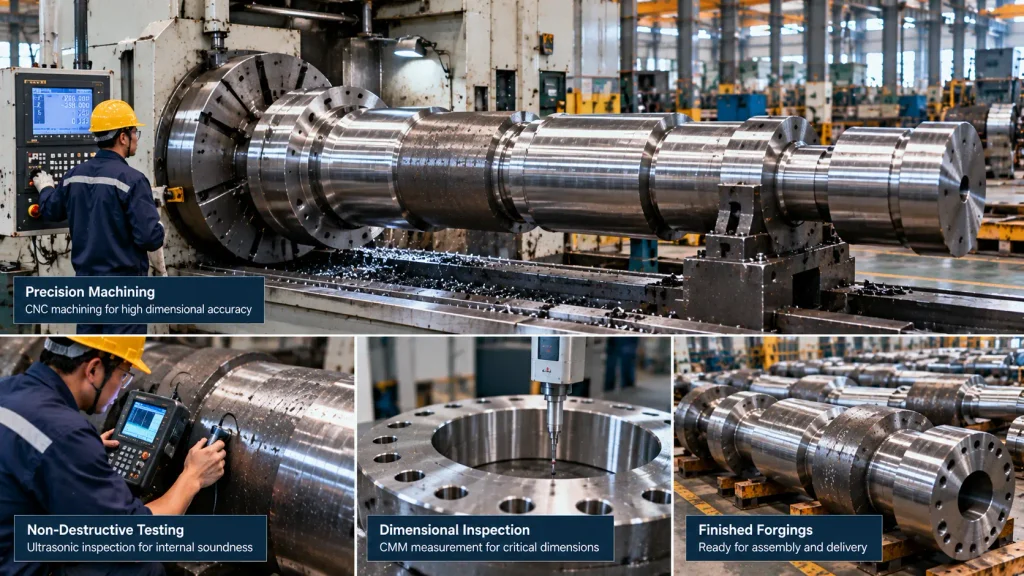
Wellhead systems contain components that connect, support and control equipment operating under pressure.
Depending on the approved design, forged products may include:
For pressure-containing components, the integrity of the material is critical.
Open-die forging and associated ring-forging processes can produce large blanks suitable for subsequent precision machining.
However, open-die forging and seamless ring rolling are related but distinct manufacturing processes. The required process should be specified rather than assumed.
The manufacturer must consider:
A forged blank cannot be considered an approved pressure-containing component solely because it has passed a basic material test.
The finished component must meet the relevant design, manufacturing, inspection and qualification requirements.
Blowout preventers (BOPs) are critical well-control equipment.
Their components may experience substantial mechanical forces and demanding pressure conditions.
Depending on the BOP design, selected structural, drive or pressure-containing components may be manufactured from forgings.
Complex load conditions
Components may be exposed to combinations of pressure, mechanical loading and repeated operation.
Material integrity
The required material properties must be achieved throughout the relevant section thickness.
Large-section heat treatment
Heavy components can be difficult to heat and cool uniformly.
Dimensional accuracy
Machined interfaces must meet the approved equipment design.
Documentation
Material, heat treatment, inspection and traceability records may be essential to acceptance.
For BOP-related parts, the customer should identify the exact component and governing equipment specification before the manufacturer recommends a forging route.
It would be inappropriate to assume that every BOP body, ram or internal component is suitable for open-die forging.
Safety-critical equipment requires engineering approval and compliance with applicable requirements.
Oilfield pumping equipment may contain large rotating shafts and mechanical drive components.
Potential applications include:
Rotating shafts depend on accurate geometry.
Important parameters may include:
The forging process establishes the material blank.
Subsequent heat treatment, machining and inspection establish the final component's functional characteristics.
A customer may specify only the shaft diameter, length and steel grade.
But a usable replacement shaft may also require detailed information about bearing seats, connection features, heat treatment and inspection.
For custom replacement work, the complete drawing is far more valuable than a simple dimensional sketch.
Large industrial valves may contain forged components designed for demanding pressure and temperature conditions.
Depending on valve type and size, possible components include:
Both manufacturing methods have important applications.
Casting can be suitable for complex valve body geometries and large internal flow passages.
Forging may be preferred where the approved design calls for specific wrought material properties, pressure-service requirements or relatively simple component geometry.
The correct choice depends on engineering requirements rather than a general assumption that one process is always better.
For forged valve components, customers should provide:
Material selection depends on operating loads, temperature, corrosion environment and equipment specifications.
The following are representative material families, not a list of universally interchangeable grades.
| Material / Specification | Typical Considerations | Potential Application |
| AISI 4140 / 42CrMo4 | Quenched-and-tempered alloy steel for mechanical strength | Shafts, gear blanks, structural components |
| AISI 4340 | High-strength alloy steel requiring controlled heat treatment | Heavy-duty drive components |
| ASTM A105 | Carbon steel forging specification for piping applications | Specified flanges, fittings and valve components |
| ASTM A182 F316 / F316L | Corrosion-resistant stainless steel forgings | Selected valves, flanges and pressure components |
| ASTM A694 grades | High-strength carbon and alloy steel forgings for transmission-service applications | Specified flanges and related components |
| Project-specific low-alloy steels | Strength, toughness and section-size requirements | Custom heavy forgings |
AISI material designations do not replace complete product specifications.
For example, specifying “4140 steel” alone does not establish the required mechanical properties, heat-treatment condition, ultrasonic acceptance level or component qualification.
Equipment exposed to hydrogen sulfide-containing environments may require additional material and hardness restrictions.
Applicable sour-service standards, such as relevant NACE MR0175 / ISO 15156 requirements, must be considered where specified.
A material's nominal corrosion resistance or strength does not automatically make it suitable for sour service.
A typical manufacturing project follows several stages.
The manufacturer evaluates:
The initial review determines whether open-die forging is technically and commercially appropriate.
A suitable steel ingot or starting stock is selected according to the approved material and manufacturing plan.
Material identification and traceability should be maintained.
The material is heated and progressively deformed using a forging press or hammer.
The forging sequence is planned around the component geometry and material requirements.
Temperature control and deformation practice influence the final metallurgical condition.
Heat treatment is performed according to the approved specification.
Depending on the material and application, this may include normalizing, annealing, quenching and tempering, or other prescribed treatments.
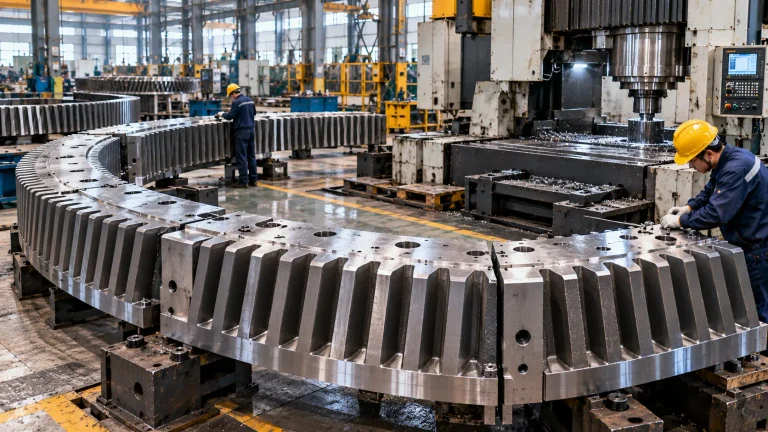
Rough machining establishes the principal geometry and removes stock for further processing.
This stage may also make certain inspections easier to perform.
Depending on the specification, inspection may include:
Inspection coverage and acceptance criteria must be defined in the approved inspection plan.
Critical surfaces are machined to the required dimensions and tolerances.
Examples include bearing journals, mounting faces, bores, threads and coupling interfaces.
The required documentation may include:
The exact document package depends on the order requirements.
For oil and natural gas equipment, API Specification 20B is particularly relevant to certain open-die shaped forgings.
It addresses requirements concerning manufacturer qualification, production, marking and documentation when invoked by the applicable equipment standard or purchase specification.
It also establishes Forging Specification Levels (FSLs) with differing technical and qualification requirements.
However, API 20B does not automatically apply to every forged shaft, bar or mechanical component used in an oilfield.
Its scope and applicability must be checked against the exact component and purchasing requirements.
Before ordering a critical oil and gas forging, customers should verify:
Important: A manufacturer should not advertise API 20B qualification or certification unless its actual status supports that claim.
Illustrative engineering scenario, not a documented LANGTENG customer project.
An oilfield equipment maintenance company needs a replacement drive shaft for an older heavy-duty gearbox.
The original shaft is no longer readily available.
The customer has an existing worn component and partial technical drawings.
The manufacturer must determine:
After verification of the engineering requirements, the manufacturer may consider:
1. Open-die forging
Produce a stepped shaft blank with suitable machining allowance.
2. Heat treatment
Achieve the approved mechanical-property requirements.
3. Rough machining and inspection
Check material condition and relevant internal quality requirements.
4. Finish machining
Machine bearing seats, connection features and other critical surfaces.
5. Final inspection
Verify dimensions, geometry and applicable material-test requirements.
The purpose of custom forging is not simply to reproduce the visible shape of the original shaft.
It is to manufacture a replacement component that satisfies the approved mechanical, dimensional and functional requirements.
When drawings are incomplete, reverse engineering must be supported by engineering verification.
Illustrative engineering scenario, not a documented LANGTENG customer project.
A wellhead equipment manufacturer needs a large forged ring blank for a custom assembly.
The component will undergo substantial precision machining.
The customer requires:
The supplier should assess whether the ring is best produced through open-die forging, seamless ring rolling or another approved route.
The decision depends on ring dimensions, cross-section, quantity and material requirements.
The forging and machining plan must also account for final inspection requirements.
The correct manufacturing route should be selected before purchasing raw material.
A well-planned forged blank can reduce machining waste and manufacturing risk, but it must still meet the approved final component specification.
For oil and gas equipment, incomplete RFQ information can lead to quotation delays and unexpected manufacturing costs.
Customers should provide the following information wherever possible.
| RFQ Information | Why It Matters |
| Equipment and application | Establishes operating context |
| Part drawing | Defines geometry and interfaces |
| Material grade and standard | Establishes material requirements |
| Forging dimensions and weight | Determines manufacturing feasibility |
| Heat-treatment condition | Defines mechanical-property targets |
| Operating pressure and temperature | Supports engineering review |
| Corrosion or sour-service conditions | Identifies additional material requirements |
| Required machining scope | Defines delivery condition |
| NDT and mechanical testing | Establishes inspection requirements |
| Applicable API / ASTM / other standards | Defines compliance obligations |
| Quantity and delivery requirements | Supports production planning |
Customers should also specify whether they require:
These options have different cost and lead-time implications.
When selecting a supplier for oil and gas equipment components, price should not be the only consideration.
Can the manufacturer produce the required dimensions, weight and geometry?
Can the required material grade and heat-treatment condition be supplied?
Can the supplier meet the specified NDT requirements?
Can the component be delivered with the required functional tolerances?
Can the supplier provide traceable records matching the purchase specification?
Can the supplier identify incomplete drawings, unclear specifications or manufacturing risks before production?
For critical oilfield components, these capabilities are more meaningful than a general claim of manufacturing experience.
LANGTENG focuses on custom heavy industrial components involving forging, casting and precision machining.
For oil and gas equipment projects, relevant manufacturing opportunities include:
Manufacturing feasibility must be confirmed against the actual component dimensions, material requirements, processing capabilities and applicable standards.
For pressure-containing or safety-critical components, customer approval and any required manufacturer qualifications are essential.
Our approach to custom manufacturing begins with understanding the intended application and the technical requirements of the finished component.
They are used to manufacture selected large shafts, rings, discs, blocks, hollow components and other custom blanks for drilling, wellhead, valve and heavy-duty mechanical equipment.
It can be suitable when the component design, material, manufacturing process, qualification and inspection meet the applicable requirements.
The forging process alone does not establish pressure-service suitability.
Forging plastically deforms solid metal, while casting solidifies molten metal in a mould.
Each process has different advantages regarding geometry, material behavior, manufacturing cost and component size.
Common material families include carbon steel, chromium-molybdenum alloy steel, nickel-chromium-molybdenum alloy steel and stainless steel.
The exact grade must be selected according to the component specification.
Open-die forging is often suitable for one-off and low-volume projects, although minimum material requirements, tooling and processing costs must be considered.
No. Applicability depends on the component, governing equipment standard and contractual requirements.
Yes, where the supplier has the necessary machining and inspection capabilities.
Customers should define whether the order covers a forging blank, rough-machined component or finished part.
Open-die forging offers an important manufacturing option for large, custom and heavy-duty oil and gas equipment components.
Its value lies in the ability to produce suitably engineered metal blanks for critical applications—not in a blanket promise of superior performance.
Successful projects require correct material selection, controlled forging and heat treatment, appropriate machining, verified inspection and clear technical documentation.
For equipment manufacturers and maintenance companies, the best results begin with a complete understanding of the finished component's function.
Need Custom Open Die Forging Parts for Oil & Gas Equipment?
LANGTENG welcomes inquiries for custom heavy-duty forged and precision-machined components.
Share your drawings, material specifications, dimensions, quantity and inspection requirements to discuss manufacturing feasibility.
Request a Custom Forging Quote
@ 2025-2026 Langteng Machinery